

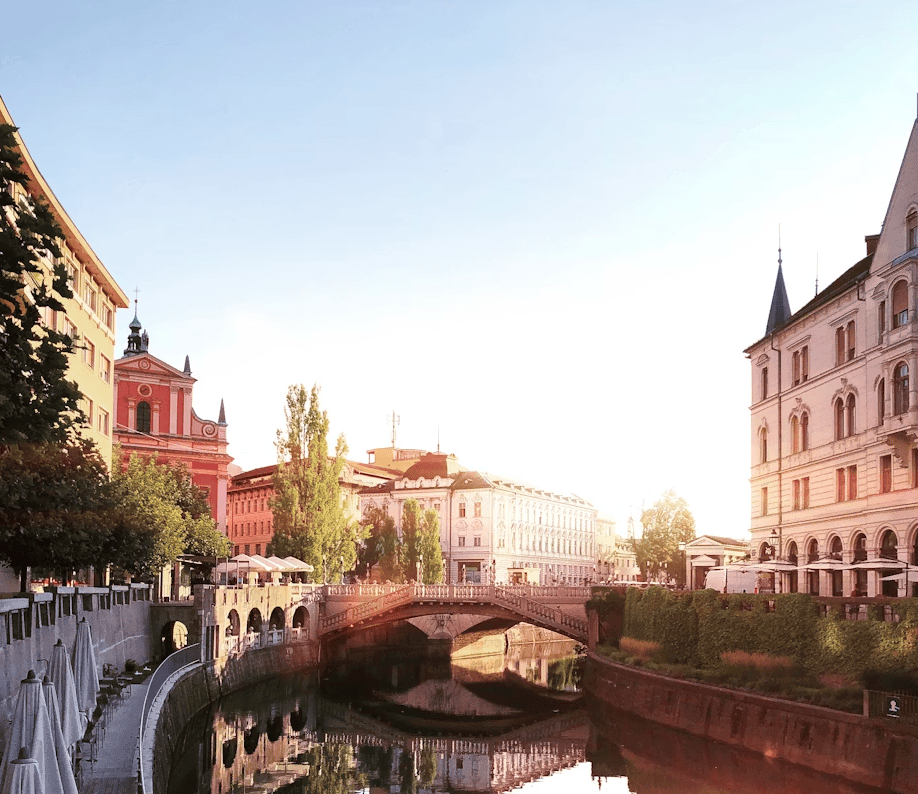
Most first-time travelers should spend 7 to 10 days in Slovenia. Seven days is enough to combine Ljubljana with Lake Bled, Lake Bohinj and either the Karst region or the Slovenian coast without turning every day into a major transfer, while ten days gives you enough room to add the Soča Valley and spend more than a single rushed night in the Julian Alps. If hiking, wine regions, eastern Slovenia or a slower road trip matter to you, approximately two weeks is a much more rewarding amount of time.
Slovenia covers only a little more than 20,000 square kilometers, but its size is one of the reasons travelers routinely underestimate how much time they can happily spend here. Within the same trip you can move between Ljubljana’s compact Central European center, glacial lakes beneath the Julian Alps, the turquoise Soča River, enormous karst caves and Mediterranean-looking towns on a coastline only a few dozen kilometers long. The distances between these regions are modest, but visiting them well is different from simply driving through them.
The ideal length also depends heavily on whether you have a car. Ljubljana and Bled are very easy to combine using public transport, Bohinj can also be reached without driving, and buses connect Ljubljana with the coast, but a car becomes much more useful once your itinerary includes the Soča Valley, Vršič Pass, rural wine areas or several attractions within the Karst region on the same day.
How Many Days Do You Need in Slovenia?
- 3 days: Ljubljana plus Lake Bled, or Ljubljana with one other major day trip.
- 4 to 5 days: Ljubljana, Lake Bled and either Lake Bohinj or the Karst region.
- 7 days: Best minimum for a varied first trip combining Ljubljana, Bled, Bohinj and the Slovenian coast or caves.
- 10 days: Ideal for adding the Soča Valley without rushing through the Alps.
- 12 to 14 days: Enough for Ljubljana, the Julian Alps, Soča Valley, Karst, coast and one additional region such as Maribor or the wine country.
- 2 weeks or more: Best for hikers, slow travelers and anyone who wants Slovenia to be the main destination rather than a short addition to a larger European trip.
Is 3 Days Enough for Slovenia?
Three days is enough for a short introduction, particularly if Slovenia is one stop on a longer Central European or Balkans itinerary, but it is not enough to understand the country’s geographical variety. The most efficient plan is to use Ljubljana as your base and devote one day to Lake Bled rather than changing accommodation repeatedly.
Ljubljana itself does not require several days of intensive sightseeing. Its historic center is compact, so one full day covers the Old Town, Triple Bridge, Dragon Bridge, Central Market, the Ljubljanica riverfront and Ljubljana Castle at a comfortable pace, while an additional evening gives you enough time to experience the restaurant and café scene rather than simply walking between landmarks.
The second full day can then be used for Lake Bled. Current 2026 schedules show numerous buses from Ljubljana to Bled taking roughly one hour to one hour and twenty minutes, which makes the lake one of the easiest major attractions in Slovenia to visit without a car.
Recommended 3-Day Slovenia Itinerary
- Day 1: Arrive in Ljubljana, explore the Old Town, Ljubljanica riverfront and Ljubljana Castle.
- Day 2: Full day trip to Lake Bled for the lakeside walk, Bled Castle, viewpoints and Bled Island if you want to take a boat.
- Day 3: Finish Ljubljana sightseeing, visit Tivoli or a museum and depart.
If caves interest you considerably more than alpine scenery, Postojna Cave can replace Bled, but attempting Ljubljana, Bled, Bohinj and Postojna within three days produces a checklist rather than a meaningful Slovenia itinerary.
Is 4 Days Enough for Slovenia?
Four days allows you to add one more major environment while keeping Ljubljana and Bled as the core of the trip. Lake Bohinj is the most natural addition if mountains are your priority, whereas Postojna Cave and Predjama Castle make more sense for travelers who want cultural and geological attractions without adding another alpine base.
Bohinj should not be treated as simply another viewpoint beside Bled. Lake Bohinj is Slovenia’s largest natural lake and lies inside Triglav National Park, with access to hiking, Mostnica Gorge, Ukanc and the Vogel cable car area. A full day here is much more useful than trying to see Bled and Bohinj in the same rushed afternoon.
Recommended 4-Day Slovenia Itinerary
- Day 1: Ljubljana.
- Day 2: Lake Bled.
- Day 3: Lake Bohinj.
- Day 4: Final Ljubljana sightseeing and departure.
Alternatively, replace Bohinj with Postojna Cave and Predjama Castle if you are traveling outside the main mountain season or simply prefer caves and historical sites to outdoor activities.
Is 5 Days Enough for Slovenia?
Five days is enough for a very good first trip if you remain selective. You can spend roughly one and a half to two days in Ljubljana, one day around Bled, one around Bohinj and use the remaining day for Postojna and Predjama or another excursion on the way back toward the capital.
This is also the point where staying overnight near Bled or Bohinj starts to make more sense than returning to Ljubljana after every alpine day. Bled receives large numbers of day visitors, and an overnight stay lets you walk around the lake early or late when the busiest excursion traffic has disappeared.
Recommended 5-Day Slovenia Itinerary
- Day 1: Arrive in Ljubljana and explore the historic center.
- Day 2: Full Ljubljana day, then travel toward Bled in the evening if convenient.
- Day 3: Lake Bled and overnight in the Alpine region.
- Day 4: Lake Bohinj, with Vogel or another outdoor activity depending on conditions.
- Day 5: Return toward Ljubljana, or visit Postojna Cave if your departure timing allows.
Five days is not the point at which I would try to add Bovec, Piran, Postojna and the entire Julian Alps. Slovenia may be compact, but every additional region introduces another hotel change, parking problem or public-transport connection that consumes time the map does not show.
Is 7 Days Enough for Slovenia?
Yes. Seven days is the best minimum for most first-time visitors because it gives you enough time to experience Slovenia’s three most distinctive environments: Ljubljana, the Alps and the Mediterranean or Karst southwest. Unlike a more aggressive itinerary that attempts to add the Soča Valley between Bohinj and Piran, this route leaves enough room to spend full days in the places you traveled to see.
For a one-week trip, I would normally postpone Bovec and the Soča Valley until a longer visit. Driving from the Bled or Bohinj region across Vršič Pass and continuing through the Soča Valley is spectacular, but doing that immediately before moving to Piran means several consecutive days become primarily road-trip days.
Recommended 7-Day Slovenia Itinerary
- Day 1: Arrive in Ljubljana, explore the Old Town and riverside.
- Day 2: Full Ljubljana day for the castle, Central Market, Tivoli and neighborhoods beyond the historic center.
- Day 3: Travel to Lake Bled and spend the day around the lake.
- Day 4: Full Lake Bohinj day, with hiking, Mostnica Gorge or Vogel depending on season and weather.
- Day 5: Travel south and visit Postojna Cave and Predjama Castle before continuing toward the coast.
- Day 6: Full day in Piran, with additional time for Portorož, Izola or another part of the Slovenian coast.
- Day 7: Return to Ljubljana and depart.
This route works particularly well with a car, but most of it can also be arranged by public transport with some changes to the sequence. Travelers without a vehicle may prefer to keep Ljubljana as a base for Postojna and then travel separately to the coast rather than trying to reproduce the exact road-trip route.
Alternative 7-Day Slovenia Itinerary Without a Car
Slovenia is entirely viable without a rental car if you accept that the public-transport version of the itinerary should not imitate a road trip exactly. Buses are especially useful for Bled and the coast, while trains can be convenient for some regional journeys.
- Day 1: Ljubljana.
- Day 2: Ljubljana.
- Day 3: Bus to Bled and overnight near the lake.
- Day 4: Bus to Bohinj and return to Bled or stay around Bohinj.
- Day 5: Return toward Ljubljana and continue to Postojna for the cave.
- Day 6: Travel to Piran or another coastal base.
- Day 7: Coast in the morning, then return toward Ljubljana.
Current Ljubljana–Bled buses often take approximately one hour to one hour and twenty minutes, while direct Ljubljana–Koper services can take around one hour and twenty minutes on faster departures. Direct services to Piran are less frequent and the journey can take approximately two hours, so always build the actual timetable for your travel date rather than assuming every coastal town has equally frequent connections.
Is 10 Days Enough for Slovenia?
Ten days is arguably the ideal first-trip length because this is where the Soča Valley can be added without sacrificing the coast or compressing Lake Bohinj into a brief stop. Three additional days over a one-week itinerary make a disproportionate difference because western Slovenia contains several attractions that are geographically close yet deserve full days outdoors.
A ten-day trip also gives you the freedom to use the scenic Vršič route as part of the experience rather than simply as a road between hotels. The pass climbs through the Julian Alps before descending into the Trenta and Soča valleys, and stopping for viewpoints, short walks and the river is precisely why the journey deserves more than a line saying “drive to Bovec.”
Recommended 10-Day Slovenia Itinerary
- Day 1: Arrive in Ljubljana.
- Day 2: Full Ljubljana day.
- Day 3: Travel to Lake Bled and stay in the Alpine region.
- Day 4: Full day at Lake Bohinj.
- Day 5: Travel toward Kranjska Gora and across Vršič Pass into the Soča Valley when the road is open.
- Day 6: Full Soča Valley day around Bovec, Trenta, waterfalls, hiking or rafting.
- Day 7: Additional Soča Valley time, then continue south or toward the Karst region.
- Day 8: Škocjan Caves or Postojna Cave and Predjama Castle.
- Day 9: Piran and the Slovenian coast.
- Day 10: Return to Ljubljana for departure.
If you prefer slower travel, remove one cave complex and spend the additional night either in Bohinj, Bovec or Piran. Postojna and Škocjan are both exceptional, but a first-time visitor does not need to see every major cave simply because they are relatively close to one another.
Is 14 Days Too Long in Slovenia?
No. Two weeks is an excellent amount of time for Slovenia if hiking, nature and regional differences are central to the trip. The national average length of an individual accommodation stay is much shorter than this, but accommodation statistics should not be confused with the ideal duration of a multi-stop itinerary, since travelers often move between several Slovenian municipalities within the same holiday.
With fourteen days, you can follow the seven- or ten-day western route at a much slower pace and still add eastern Slovenia, which is almost completely absent from many first-time itineraries. Maribor, Ptuj, wine country and spa regions reveal a different side of the country from the Julian Alps and Adriatic coast.
Recommended 14-Day Slovenia Itinerary
- Day 1: Arrive in Ljubljana.
- Day 2: Ljubljana.
- Day 3: Additional Ljubljana time or a nearby excursion such as Škofja Loka.
- Day 4: Lake Bled.
- Day 5: Lake Bohinj.
- Day 6: Additional Bohinj hiking or Alpine day.
- Day 7: Kranjska Gora and Vršič Pass when conditions allow, continuing into the Soča Valley.
- Day 8: Bovec and the Soča Valley.
- Day 9: Additional Soča day for rafting, hiking or Kobarid.
- Day 10: Škocjan Caves, Postojna or Predjama.
- Day 11: Piran and the coast.
- Day 12: Additional coast day or travel east.
- Day 13: Maribor, Ptuj or a wine-region stop.
- Day 14: Return toward Ljubljana and depart.
Hikers could easily use those fourteen days differently by spending several nights in Bohinj and the Soča Valley and skipping eastern Slovenia entirely. Slovenia is compact geographically, but its outdoor regions reward depth far more than rapidly accumulating destinations.
How Many Days Do You Need in Ljubljana?
One full day covers Ljubljana’s essential historic center, but two days is better for most first-time visitors. The city is small enough that you do not need three or four days simply to reach its major sights, yet it is enjoyable enough that treating it only as an airport and transport hub is equally unnecessary.
Use the first day for the Old Town, Triple Bridge, Dragon Bridge, Central Market, riverside and Ljubljana Castle. A second allows Tivoli Park, museums, architecture, neighborhoods beyond the pedestrian center and enough unstructured time to enjoy cafés and restaurants rather than constantly moving toward another landmark.
Three nights in Ljubljana also works well if you prefer one base and want to take day trips to Bled, Postojna or nearby historic towns rather than changing accommodation frequently.
How Many Days Do You Need at Lake Bled?
One full day is enough for the main Lake Bled experience, while one or two nights is preferable if you want hiking, swimming or quieter early-morning and evening hours. You can walk around the lake, visit Bled Castle, take a traditional pletna or another boat to Bled Island and still have time for one viewpoint during a full day.
Bled is also one of Slovenia’s most visited destinations, so staying overnight has more value than the raw sightseeing time suggests. The character of the lake changes once large numbers of day visitors have returned to Ljubljana or continued elsewhere.
If you are primarily using Bled as an introduction to the Julian Alps, one night is enough before continuing to Bohinj. If you are traveling slowly or want several hikes, two or three nights becomes easy to justify.
How Many Days Do You Need at Lake Bohinj?
One full day is the minimum I would recommend, while two or three days works much better for hikers and outdoor travelers. Bohinj is larger and less concentrated than Bled, and many of its best experiences require leaving the immediate lakeshore.
You can use one day for Ribčev Laz, the lake, Ukanc and Vogel, while a second creates room for Mostnica Gorge, hiking or simply spending more time in Triglav National Park without constantly checking the departure time of the next bus.
One important transport detail is that trains do not arrive directly beside Lake Bohinj. Rail services reach Bohinjska Bistrica, from where local buses or seasonal organized transport continue to the lake. During summer 2026, Bohinj’s official train packages explicitly combine the railway journey to Bohinjska Bistrica with onward bus transportation to Lake Bohinj.
How Many Days Do You Need in the Soča Valley?
Two full days is the useful minimum, while three nights is ideal if hiking, rafting or photography is a major reason for visiting Slovenia. The Soča Valley is not one single viewpoint outside Bovec; it stretches through Trenta, Bovec, Kobarid and Tolmin, with gorges, waterfalls, historic sites and hiking routes distributed along the valley.
One day works for a road-trip introduction, but you will spend a significant part of it moving between attractions. Two days allows one active day and one slower sightseeing day, while three days gives you enough flexibility for weather, which matters considerably in an Alpine environment.
How Many Days Do You Need in Bovec?
Two nights is a practical minimum if Bovec is your Soča Valley base. The town itself does not require two full sightseeing days, but it provides access to rafting, kayaking, waterfalls, the upper Soča and numerous mountain routes.
Travelers interested primarily in towns and architecture can move through more quickly, while hikers and adventure travelers can easily spend four or five nights in the area without exhausting the possibilities.
How Many Days Do You Need in Piran?
One full day and one overnight stay is enough for Piran’s principal sights, while two nights is better if you want the coast to feel like a genuine part of the trip rather than a final photograph before returning to Ljubljana.
Piran’s historic core is small, so you can cover Tartini Square, the waterfront, the Church of St. George and the old streets within several hours. The reason to remain longer is the Mediterranean atmosphere, swimming and the possibility of combining Piran with Portorož, Izola, Koper or the nearby salt pans.
A two-day coastal section is therefore much more valuable than allocating two uninterrupted sightseeing days solely to Piran’s old center.
How Many Days Do You Need for Postojna Cave and Predjama Castle?
One day is enough to combine Postojna Cave and Predjama Castle. During the main 2026 summer period, an official shuttle operates between the two attractions, with the journey taking approximately twenty minutes, which also makes the combination practical for travelers without their own car.
Postojna Cave uses timed entry, so the visit should not be treated as an attraction where you can always arrive whenever you happen to pass. The official park recommends buying online in advance and specifically advises summer visitors to purchase at least one day before their intended visit.
That recommendation is not merely theoretical. On August 21, 2026, Predjama Castle completely sold out for the day, and visitors without advance tickets were asked not to travel to the castle. During July and August, building this section of the itinerary around a confirmed reservation is therefore much safer than assuming same-day availability.
Postojna or Škocjan Caves: Do You Need Both?
No. Both are important cave systems, but travelers with only five or seven days in Slovenia should not feel that seeing both is necessary. Postojna offers the famous underground railway and highly developed visitor infrastructure, while the UNESCO-listed Škocjan Caves are particularly known for their enormous underground canyon and more dramatic natural scale.
If you have ten days or more and caves are a genuine interest, visiting both can make sense. On a shorter trip, choose one and use the saved day for Bohinj, Soča or the coast.
How Many Days Do You Need in Triglav National Park?
The answer ranges from one day to more than a week depending on what you mean by visiting Triglav National Park. Lake Bohinj and parts of the Soča Valley already place you within or beside the protected Alpine landscape, so a traveler can experience the park without undertaking a multi-day mountain trek.
For ordinary sightseeing and moderate hiking, two to four days distributed between Bohinj and the western Julian Alps provides a strong introduction. Travelers planning hut-to-hut routes, technical mountain terrain or an ascent of Triglav itself need a completely different itinerary and should allocate additional days for both the route and changing weather.
How Long Do You Need for Vršič Pass?
Driving directly across Vršič Pass does not take an entire day, but treating it only as a transport connection misses the reason for using the route. The road contains numerous bends, mountain huts, viewpoints and access points for walks, and the descent through Trenta leads naturally toward the upper Soča Valley.
Allow at least half a day if traveling from Kranjska Gora toward Bovec and you expect to stop along the way. In summer 2026, a free public bus also operates between Kranjska Gora and Bovec across Vršič from June through September, making the route possible for travelers who do not want to drive the mountain road.
The pass is not a reliable year-round link. Winter snow can close the road for part of the year, and temporary closures can also occur because of road works, cycling events or other traffic management. Check the current road status before building an itinerary that depends on crossing Vršič on a particular day.
Can You Visit Slovenia Without a Car?
Yes. A first trip centered on Ljubljana, Bled, Bohinj and the coast can be built entirely around buses and trains, although some journeys require transfers and less flexibility than driving.
Current 2026 buses connect Ljubljana with Bled frequently, with many journeys taking around an hour. Ljubljana to Koper can take approximately one hour and twenty minutes on faster direct buses, while Piran also has direct connections on selected departures.
Bohinj is also accessible without a car, but travelers should understand the distinction between the railway and the lake itself. Trains serve Bohinjska Bistrica, and buses continue from there toward Ribčev Laz, Ukanc and other lake destinations.
The Soča Valley is the region where public transport requires more advance planning. Seasonal services improve access considerably during summer, including the 2026 bus across Vršič, but a rental car remains more convenient for travelers trying to combine numerous waterfalls, trailheads and villages within limited time.
Is Slovenia Better by Car or Public Transport?
Neither option is universally better. Public transport makes excellent sense if your trip is primarily Ljubljana, Bled and several established tourist destinations, while a car becomes increasingly valuable as you add the Soča Valley, Karst countryside, smaller wine regions and multi-stop road-trip days.
The best compromise for many travelers is to spend Ljubljana without a car, use public transport for the capital and perhaps Bled, then rent a vehicle for the Soča, caves and coastal portion. This avoids paying for parking while the car sits unused in Ljubljana but preserves flexibility where it matters more.
What Affects How Long You Should Stay in Slovenia?
Your Interest in Hiking
Hiking changes the answer more than almost any other preference. Someone who wants only the main viewpoints can visit Bled and Bohinj in two days, while a traveler interested in full-day routes, mountain huts and the high Julian Alps could spend the entire week in the same part of Slovenia.
Do not count a serious hiking day as though it were another sightseeing stop before a long afternoon transfer. Starting early, completing the route, eating and recovering generally makes that region your entire day.
Whether You Have a Car
Slovenia’s public transport is sufficient for many standard itineraries, but the country becomes easier to explore quickly with a car once you move beyond the principal urban and tourist corridors.
A driver can combine Predjama with Postojna, stop between Bled and Bohinj or move through several Soča Valley locations without adapting the entire day to a timetable. Travelers without a car should compensate with slightly fewer stops rather than assuming public transport will reproduce the same itinerary minute for minute.
The Season
Summer provides the widest access to high mountain roads and hiking routes, but it also brings the strongest visitor pressure around Bled, Bohinj, the coast and major attractions. June and September often provide a better balance for a broad outdoor road trip, although mountain conditions should still be checked individually.
Winter is not simply a quieter version of summer. Vršič can be closed by snow, high hiking routes become winter mountaineering terrain and the itinerary shifts toward cities, caves and actual ski areas such as Kranjska Gora and Vogel rather than ordinary lake sightseeing.
Seasonal Transport and Attractions
Some itinerary elements operate differently according to the month. The summer bus across Vršič is seasonal, Bohinj runs additional organized local transport during the main visitor period and cable cars can have seasonal timetables or maintenance closures.
In 2026, for example, Vogel has announced an extended maintenance closure beginning September 21 and expected to continue until approximately the end of November. Travelers specifically planning to use the Vogel cable car during that period should build a different Bohinj day rather than assuming a standard summer itinerary will still work.
How Often You Want to Change Hotels
Slovenia’s short distances tempt travelers into sleeping somewhere new every night, but this rarely produces a more enjoyable trip. Packing, parking, check-in and luggage storage still take time even when the next hotel is only ninety minutes away.
Use regional bases instead. Bled or Bohinj can cover several Alpine days, Bovec works for the Soča Valley, and Piran or another coastal town can cover the short Slovenian coastline.
Slovenia by Trip Length
- Weekend: Ljubljana with one nearby excursion.
- 3 days: Ljubljana and Lake Bled.
- 4 days: Add Bohinj or Postojna.
- 5 days: Ljubljana, Bled, Bohinj and one Karst attraction.
- 7 days: Ljubljana, Bled, Bohinj, Postojna or Škocjan and the coast.
- 10 days: Add the Soča Valley and Vršič route.
- 12 days: More hiking time or an additional regional section.
- 14 days: Comfortable full-country introduction with western Slovenia and part of the east.
- 3 weeks: Enough for slow Alpine travel, multiple hiking days, wine regions, spas and less-visited towns.
Common Slovenia Itinerary Mistakes
Trying to Include the Soča Valley in an Already Full 7-Day Route
Bovec and the Soča Valley deserve more than a night squeezed between Bohinj and Piran. If you have seven days, prioritize Ljubljana, the lakes and the southwest. Add Soča when you have around ten days or make it one of the main regions of a shorter nature-focused trip.
Seeing Bled and Bohinj as the Same Destination
The lakes are geographically close but provide different experiences. Bled is compact, iconic and highly developed for tourism, while Bohinj is larger, quieter and much more closely tied to hiking and Triglav National Park.
You can technically visit both in one day, but giving each a dedicated day is considerably more satisfying if you have a week in Slovenia.
Assuming the Train Goes Directly to Lake Bohinj
The railway stops at Bohinjska Bistrica rather than on the lake shore. From there, continue by bus or seasonal organized transport toward Lake Bohinj, Ribčev Laz or Ukanc.
Assuming Vršič Pass Is Always Open
Vršič can close because of winter snow and may also experience temporary traffic restrictions during the warmer season. A road-trip itinerary that depends on the pass should always have an alternative route and should check current conditions shortly before travel.
Trying to Drive Vršič Without Leaving Time to Stop
The value of the route is the scenery rather than simply reaching Bovec. If your schedule allows only enough time to drive continuously from one hotel to another, the route has been allocated too little time.
Leaving Postojna Tickets Until the Last Minute in Summer
Postojna Cave has timed tours, and the official attraction recommends buying online in advance and at least one day ahead during summer. Same-day availability cannot be assumed during the busiest period, particularly for combinations involving Predjama Castle.
Assuming Bled Is a Major Ski Resort
Bled is an Alpine destination, but it should not be listed alongside Slovenia’s principal ski areas as though skiing were the main reason to stay beside the lake in winter. For a ski-oriented trip, Kranjska Gora and Vogel above Bohinj are much more relevant choices.
Changing Accommodation Every Night
Slovenia is exactly the kind of country where short distances make excessive hotel changes appear harmless. They still consume time. Two nights in Bohinj or Bovec generally creates a better experience than sleeping in Bled, Bohinj, Kranjska Gora and Bovec on four consecutive nights.
How Many Days for Slovenia and Croatia?
For a first trip combining both countries, approximately 12 to 14 days is a much better starting point than trying to fit them into one week. Seven days in Slovenia and another five to seven in one part of Croatia provides enough room for a coherent route without spending most of the holiday moving between countries.
Ten days can work if you limit both sides deliberately, for example five days around Ljubljana and the Julian Alps followed by five days in Zagreb and Istria. It is not enough for a full Slovenia circuit followed by Zagreb, Plitvice, Split and the Croatian islands.
How Many Days for Slovenia and Italy?
Slovenia combines particularly well with northeastern Italy because the Soča Valley, Karst region and coast sit close to the Italian border. Around ten to fourteen days works well for a route involving Slovenia plus Trieste, Venice or Friuli, depending on how much of each country you want to see.
If Venice is only an arrival or departure point, you do not necessarily need several additional days. If Italy is intended to become an equal half of the holiday, treat it as a separate itinerary rather than an extension of the final Slovenia afternoon.
How Many Days for Slovenia and Austria?
Slovenia and Austria are also easy to combine, particularly through Ljubljana, Maribor and the Alpine north. Ten to fourteen days is a useful range for a trip linking Slovenia with Graz, Salzburg or southern Austria, but the appropriate split depends on whether cities or Alpine landscapes are your priority.
Frequently Asked Questions
How many days in Slovenia is enough?
Seven days is enough for a very good first trip covering Ljubljana, Lake Bled, Lake Bohinj and the Karst or coast. Ten days is better if you also want the Soča Valley, while approximately two weeks provides enough time for slower hiking and additional regions.
Is 3 days enough for Slovenia?
Three days is enough for Ljubljana and Lake Bled but not for a representative trip through the country. It works well for a short city-and-lake break or as one section of a larger European itinerary.
Is 4 days enough for Slovenia?
Yes for a focused first visit. Four days can cover Ljubljana, Bled and either Bohinj or Postojna, but it leaves no useful room for the Soča Valley or coast.
Is 5 days enough for Slovenia?
Yes. Five days gives you enough time for Ljubljana, Bled, Bohinj and one additional attraction such as Postojna Cave. Keep the number of hotel changes low and do not attempt to add every major region.
Is 7 days enough for Slovenia?
Yes. Seven days is the recommended minimum for a varied first trip. Ljubljana, Bled, Bohinj and the southwestern Karst or coastal region fit comfortably, while the Soča Valley is better saved for a longer itinerary.
Is 10 days enough for Slovenia?
Ten days is an excellent duration because it allows you to add the Soča Valley and Vršič route without reducing the lakes or coast to brief stops. For many travelers, this is the ideal first-trip length.
Is two weeks too long in Slovenia?
No. Two weeks is especially suitable for hiking, road trips and travelers interested in eastern Slovenia as well as the famous western highlights. You can spend several nights in each outdoor region and still add Maribor, Ptuj or wine country.
How many days do you need in Ljubljana?
One full day covers the main historic sights, while two days is ideal for most first-time visitors. Three nights works particularly well if Ljubljana is being used as a base for day trips.
How many days do you need at Lake Bled?
One full day is enough for the principal attractions, while one or two nights gives you time for viewpoints, swimming and quieter hours around the lake.
How many days do you need at Lake Bohinj?
Allow at least one full day. Two or three days is much better if you plan to hike, visit Mostnica Gorge or use Bohinj as a base for Triglav National Park.
Can you visit Bled and Bohinj in one day?
Yes, but it is a compromise. The two lakes are close enough to combine, particularly with a car or organized excursion, but travelers with seven days or more should generally give them separate days.
How many days do you need in the Soča Valley?
Two full days is a useful minimum, while three nights provides better flexibility for hiking, rafting, Kobarid and changing mountain weather.
How many days do you need in Piran?
One full day covers Piran itself, while two nights works better if you want swimming and additional coastal towns such as Izola or Koper.
Can you travel around Slovenia without a car?
Yes. Ljubljana, Bled, Bohinj, Postojna and the coast can all be reached using public transport, although some journeys require transfers. A car becomes most useful for the Soča Valley, rural Karst areas and itineraries containing several small stops in one day.
How long is the bus from Ljubljana to Lake Bled?
Current 2026 schedules include journeys of roughly one hour to one hour and twenty minutes, depending on the service and stops. Bled is therefore easy to visit as a day trip from Ljubljana.
Can you take a train to Lake Bohinj?
Not directly to the lake. Trains reach Bohinjska Bistrica, after which you need a bus or seasonal local transport to continue toward Lake Bohinj. During summer 2026, official Bohinj packages combine precisely these two forms of transport.
Is Vršič Pass open all year?
No. The pass can close during winter because of snow and can also experience temporary restrictions or closures at other times. Always check current road conditions if your itinerary depends on crossing between Kranjska Gora and the Soča Valley.
How many days do I need for Slovenia and Croatia?
Approximately 12 to 14 days is a comfortable minimum for meaningful first trips through both countries. Ten days can work if each country is limited to a small number of destinations.
What is the ideal Slovenia itinerary for a first-time visitor?
With seven days, combine Ljubljana, Bled, Bohinj and the Karst or coast. With ten days, add the Soča Valley. With two weeks, slow the western route down and add eastern Slovenia or additional hiking rather than simply accumulating more overnight stops.
So, How Many Days Should You Spend in Slovenia?
If you want one number, choose seven days. A week is enough to experience Ljubljana as a city rather than only an arrival point, spend meaningful time at both Bled and Bohinj and finish with a completely different Slovenian landscape around the Karst caves or Mediterranean coast.
Ten days is better if the Soča Valley appears on your must-see list. Those additional days allow Vršič Pass and the upper Soča to become part of the trip itself instead of forcing you to cross the Julian Alps in the morning and leave western Slovenia again almost immediately.
Two weeks is worthwhile for hikers and slower travelers because Slovenia’s small geographical scale does not make its regions interchangeable. Bohinj, Bovec, Piran and eastern wine country all reward multiple nights for different reasons, and the country becomes more interesting rather than repetitive when you stop treating every short driving distance as proof that another destination should be added.
If you have only three to five days, stay selective. Ljubljana and Bled form the easiest short introduction, with Bohinj or Postojna as the natural next addition. A successful Slovenia itinerary is not the one that proves you can cross the entire country quickly; it is the one that leaves enough time to actually hike, swim, explore or sit beside the river once you arrive.
 admin
admin