

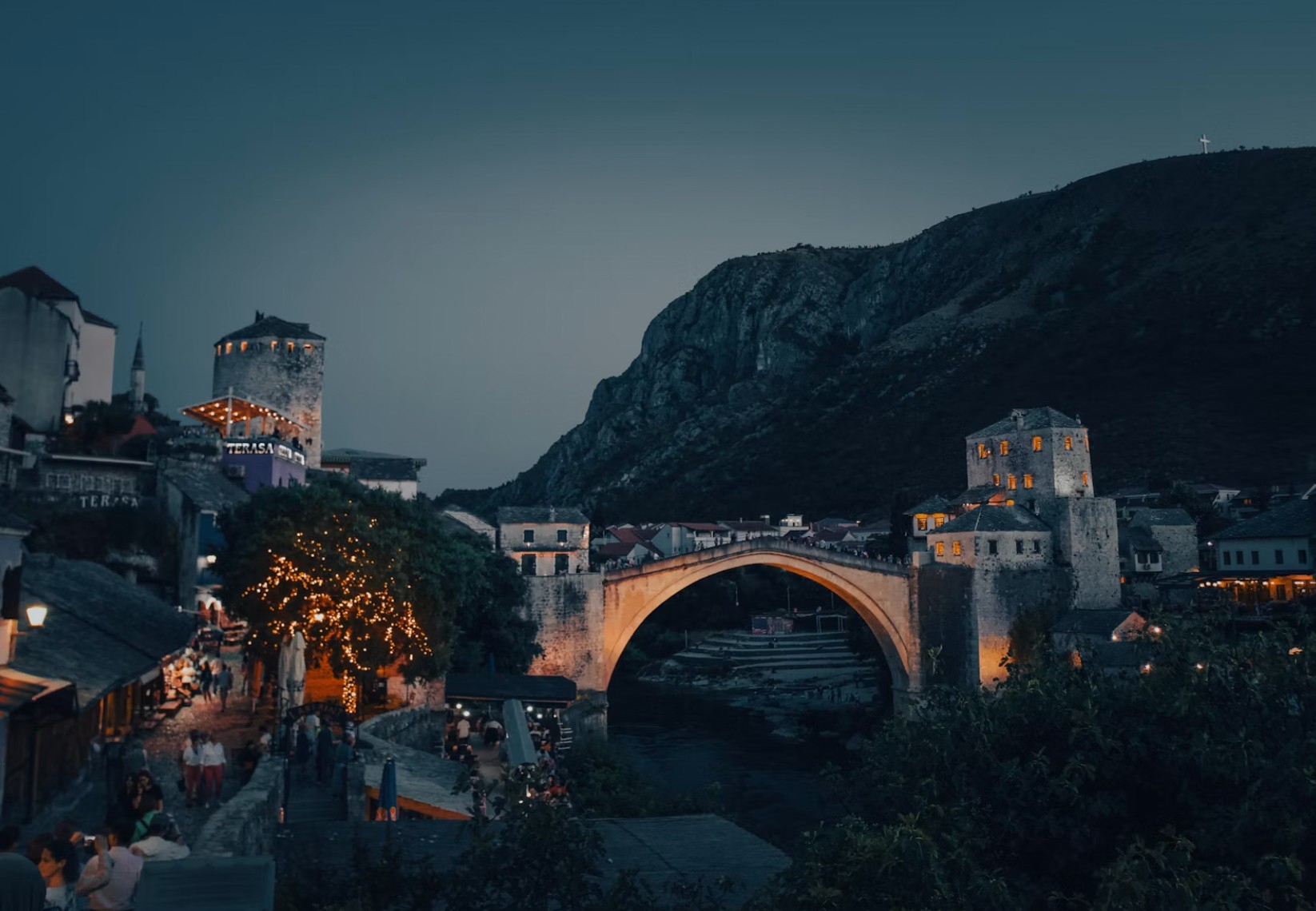
Yes, Bosnia and Herzegovina is still one of the more affordable countries to visit in Europe in 2026, particularly if your trip is built around Sarajevo, Mostar, local restaurants and public transportation rather than private tours and a rental car for the entire journey. Food remains inexpensive, city transport costs only a few convertible marks, hostel beds are widely available for well under €20 and the scenic train between Sarajevo and Mostar costs less than many airport transfers elsewhere in Europe.
The country is not equally cheap everywhere, however. Accommodation in Sarajevo can become considerably more expensive during the Sarajevo Film Festival and other major events, Mostar has a pronounced summer tourism season, and reaching places such as Sutjeska National Park, Una National Park or remote mountain areas can require a rental car, driver or organized excursion. Travelers who stay mainly in cities can therefore spend dramatically less than visitors building a road trip through the country’s national parks and rural regions.
For most independent travelers, approximately €35–50 per person per day is a realistic budget range, while €60–90 provides a comfortable mid-range trip with private accommodation and regular restaurant meals. Travelers choosing better hotels, rental cars, rafting, private transfers and organized excursions should plan approximately €110–170 or more per day. If you are still deciding how long to stay, our guide to how many days you need in Bosnia and Herzegovina explains what realistically fits into 3, 5, 7, 10 and 14-day trips.
How Much Does It Cost to Visit Bosnia and Herzegovina in 2026?
The largest expenses are accommodation and regional transportation rather than food or ordinary sightseeing. Sarajevo and Mostar are easy to explore without a car, and traveling between them by train is particularly inexpensive, while routes involving mountain villages, waterfalls and national parks usually require more money for transportation.
- Budget traveler: approximately €35–50 per person per day.
- Mid-range traveler: approximately €60–90 per person per day.
- Comfortable traveler: approximately €110–170+ per person per day.
- Road-trip traveler: approximately €80–130+ per person per day when accommodation and the vehicle are shared.
- Peak-summer or festival city break: approximately €90–150+ per person per day if hotel prices rise substantially.
These figures exclude international airfare because the cost of reaching Sarajevo, Mostar, Tuzla or Banja Luka varies much more according to your departure airport than according to expenses within Bosnia and Herzegovina itself.
How Much Does One Week in Bosnia and Herzegovina Cost?
For a seven-day trip without international flights, the following ranges provide a useful starting point:
- Budget trip: approximately €245–350 per person.
- Mid-range trip: approximately €420–630 per person.
- Comfortable trip: approximately €770–1,190+ per person.
A budget week could combine Sarajevo and Mostar using hostels, local restaurants and trains, with perhaps one inexpensive regional day trip. At the mid-range level you can add private guesthouses or three-star hotels, regular restaurant meals, museum admissions, occasional taxis and excursions around Herzegovina.
The upper range becomes much more relevant if you rent a car, spend several days in national parks or book private tours. Bosnia and Herzegovina is mountainous, and a destination that appears geographically close can still involve substantial driving time, so adding more stops does not merely increase fuel expenditure but can also create extra nights in different accommodation.
What Currency Does Bosnia and Herzegovina Use?
Bosnia and Herzegovina uses the convertible mark, usually abbreviated BAM internationally and KM locally. The currency is permanently pegged to the euro through the country’s currency-board system.
The official fixed exchange rate is 1 EUR = 1.95583 BAM, which makes travel budgeting unusually simple. For everyday mental calculations, treating 2 BAM as approximately €1 is accurate enough for almost every small purchase.
- 2 BAM is approximately €1.
- 10 BAM is approximately €5.10.
- 20 BAM is approximately €10.20.
- 50 BAM is approximately €25.60.
- 100 BAM is approximately €51.
- 200 BAM is approximately €102.
This fixed relationship also means that currency fluctuations against the euro are not something you need to monitor while planning the trip.
Can You Pay in Euros in Bosnia and Herzegovina?
Some hotels, tourism businesses and businesses close to the Croatian border may accept euros informally, but you should not build your trip around paying in euros. The official currency is BAM, and using it avoids poor informal exchange rates and confusion over change.
Cash remains more important here than in many Western European destinations. Cards work in larger hotels, supermarkets and many restaurants in Sarajevo and Mostar, while bakeries, small cafés, rural guesthouses, markets and some attraction ticket offices may still prefer or require cash.
For more practical details covering cash, transportation, entry requirements and everyday logistics, see our Bosnia and Herzegovina travel tips.
Is Bosnia and Herzegovina Still Cheap in 2026?
Yes, particularly at the budget and mid-range levels. A simple restaurant meal commonly costs around 10–15 BAM, equivalent to roughly €5–8, while a more substantial sit-down dinner is still considerably cheaper than an equivalent meal in Western Europe or Croatia’s most tourism-heavy coastal destinations.
Coffee is another category where the country feels inexpensive. Traditional Bosnian coffee and ordinary café drinks often cost only a few convertible marks, while local beer remains relatively affordable even in major cities.
The affordability becomes less dramatic once you move into hotels and international tourism products. A conventional three-star hotel in Sarajevo or Mostar can easily cost €50–70 or more per room, especially during busy periods, and private transfers or guided full-day excursions are priced at a very different level from a local bus ticket or plate of ćevapi.
Accommodation Costs in Bosnia and Herzegovina
Accommodation ranges from exceptionally cheap hostel beds and family guesthouses to international hotels and mountain resorts. Sarajevo has the broadest range, while Mostar offers some of the cheapest backpacker accommodation despite its enormous popularity with international visitors.
Useful 2026 planning ranges are:
- Hostel dorm bed: approximately €8–18 per person.
- Simple guesthouse or basic private room: approximately €20–40 per room.
- Budget hotel or apartment: approximately €30–50 per room.
- Comfortable three-star hotel: approximately €50–75 per room.
- Better four-star hotel: approximately €75–120+ per room.
- Peak dates in Sarajevo or Mostar: conventional hotels can rise well above normal averages.
Couples receive particularly good value because guesthouses and hotel rooms are normally priced per room rather than per person. A €60 room costs €30 each for two people but consumes a much larger part of a solo traveler’s daily budget.
How Much Does Accommodation Cost in Sarajevo?
Sarajevo offers extremely inexpensive accommodation at the bottom of the market. Current hostel listings show dorm beds beginning around £8–10 on some dates, with numerous options in and around the central districts.
Conventional hotels cost considerably more. Current Booking.com data puts three-star accommodation broadly around the equivalent of approximately $60–80 per room depending on the market view and dates, while four-star hotels sit significantly higher. These averages should not be confused with the cheapest room available: apartments and locally run guesthouses can be found for considerably less.
A realistic planning range is around €25–45 for a simple private room and approximately €50–80 for a comfortable conventional hotel. Sarajevo Film Festival dates, major conferences and particularly busy summer weekends can push those figures upward.
Staying slightly outside Baščaršija can save money without making sightseeing difficult because central Sarajevo is compact and public transport is inexpensive.
How Much Does Accommodation Cost in Mostar?
Mostar is particularly attractive to backpackers. Current Hostelworld listings show beds around £7–12 at many properties, and inexpensive guesthouse rooms can also be found close to the Old Town.
Current Booking.com data places a cheap hotel at around $55 per night on average, while three-star properties are roughly around the $70–80 range. The actual rate depends heavily on dates, and summer weekends can be considerably more expensive.
For most travelers, approximately €20–40 is a useful range for simple private accommodation and around €45–70 for a comfortable conventional room. Staying several streets away from Stari Most usually provides better value than insisting on a direct bridge view.
Mostar is compact enough that accommodation does not need to be directly beside the Old Bridge. A ten-minute walk can significantly broaden the selection without creating meaningful transportation costs.
Is Sarajevo or Mostar Cheaper?
The two cities are relatively close in overall travel cost. Mostar can be cheaper for hostels and simple guesthouses, while Sarajevo has a much larger accommodation market and therefore more choice across different price categories.
Food costs are similar, although restaurants immediately surrounding Stari Most can charge more than ordinary local restaurants elsewhere in Mostar. Sarajevo also has a larger upscale dining and hotel market, creating a higher ceiling for travelers who want premium experiences.
For an ordinary budget or mid-range visitor, the difference is rarely large enough to choose one city over the other based purely on cost.
How Much Does Food Cost in Bosnia and Herzegovina?
Food remains one of the best-value parts of traveling through Bosnia and Herzegovina. Traditional cuisine is filling, portions are often substantial and some of the country’s most recognizable dishes are sold in inexpensive neighborhood restaurants rather than premium establishments.
Useful planning benchmarks are:
- Inexpensive local restaurant meal: approximately 10–15 BAM.
- Mid-range restaurant meal per person: approximately 20–30 BAM.
- Three-course dinner for two: approximately 50–70 BAM.
- Burek or another bakery meal: commonly only a few BAM.
- Coffee: approximately 2.5–4 BAM in many ordinary cafés.
- Domestic beer: approximately 3–5 BAM depending on location.
This means €15–20 per person per day can cover food for a careful traveler using bakeries and inexpensive restaurants, while around €25–40 provides enough flexibility to eat in sit-down restaurants throughout the day.
How Much Does Food Cost in Sarajevo?
Sarajevo remains exceptionally good value for travelers interested in traditional food. Baščaršija contains numerous ćevabdžinice, buregdžinice and aščinice where a complete meal can cost much less than a conventional international restaurant.
The famous ćevapi, burek, begova čorba and other local dishes can usually be eaten cheaply without leaving the historic center, although restaurants designed primarily for international tourists can charge more.
A realistic Sarajevo food budget is around €15–25 per person per day for careful travel and approximately €25–40 for someone eating most meals in restaurants and adding coffee, desserts and drinks.
How Much Does Food Cost in Mostar?
Mostar’s inexpensive restaurant meal is commonly around 12 BAM in current 2026 travel-price datasets, while a mid-range dinner for two is often around 60–65 BAM. Restaurants immediately beside the Old Bridge can be more expensive than places a few streets away.
This gives travelers a simple way to save money without sacrificing food quality: walk out of the busiest section of the Old Town before choosing a restaurant. The difference can be more meaningful than trying to save one or two BAM by avoiding traditional dishes altogether.
Cheap Bosnian Food to Try
Many of Bosnia and Herzegovina’s most characteristic foods happen to be inexpensive, which makes traveling on a low food budget much more enjoyable than relying on supermarket sandwiches.
- Ćevapi served in somun with onions.
- Burek filled with meat.
- Sirnica and zeljanica for inexpensive bakery meals.
- Begova čorba and other traditional soups.
- Dolma and stuffed vegetables.
- Klepe, Bosnian-style dumplings.
- Bosanski lonac for a more substantial traditional meal.
- Tufahija and baklava for inexpensive desserts.
- Bosnian coffee served in a traditional džezva.
Using bakeries for breakfast or lunch is particularly effective because a filling pastry costs very little and leaves more room in the budget for a proper dinner.
How Cheap Is Public Transport in Sarajevo?
Sarajevo public transportation is inexpensive. Current GRAS pricing puts a single tram, trolleybus or ordinary city-bus ride at 2.20 BAM, which is only a little over €1.
- Single tram ride: 2.20 BAM.
- Single trolleybus ride: 2.20 BAM.
- Ordinary city bus ride: 2.20 BAM.
- Express bus ticket: 2.70 BAM.
- Daily ticket: from 7.10 BAM.
Many of Sarajevo’s central attractions are also within walking distance of one another, so a visitor staying near Baščaršija may spend very little on transport during an entire day.
How Much Is the Train From Sarajevo to Mostar?
The Sarajevo–Mostar railway is one of the strongest transport bargains in the country. Current 2026 timetables list two daily trains from Sarajevo to Mostar, with the journey taking approximately two hours and second-class fares beginning around 13.90 BAM, or roughly €7.
That makes the train both cheaper than many current bus departures and more scenic. The route follows the Neretva through Konjic and Jablanica and is widely considered one of the most memorable train journeys in the Balkans.
Current railway operations can change, particularly around seasonal international services, so check ŽFBH close to your travel date rather than relying entirely on an old timetable.
How Much Is the Bus From Sarajevo to Mostar?
Buses run much more frequently than trains. Current 2026 listings show fares varying considerably by company and booking platform, with many departures around €14–19.
The bus therefore offers flexibility rather than necessarily being the cheapest option. If one of the two daily train times fits your itinerary, rail can provide considerably better value.
Can You Travel Bosnia and Herzegovina Without a Car?
Yes, particularly if your itinerary is based around Sarajevo, Mostar, Konjic and other larger towns. Buses connect the major cities and the Sarajevo–Mostar train covers the country’s most popular tourism corridor.
Public transportation becomes less convenient when the itinerary expands into national parks and dispersed rural attractions. Kravica Waterfall, Sutjeska, Una National Park, remote mountain villages and some monasteries are far easier to combine using a rental car or organized excursion.
If you are planning your first route, our first-time Bosnia and Herzegovina guide covers the trade-offs between buses, trains and driving in more detail.
How Much Does It Cost to Rent a Car in Bosnia and Herzegovina?
Car-rental prices vary dramatically by month. Current 2026 comparison data shows Bosnia and Herzegovina as inexpensive during winter and shoulder season but substantially more expensive during July and August.
At Sarajevo Airport, representative average prices are approximately:
- January: around €10 per day.
- March: around €14 per day.
- April: around €22 per day.
- May: around €26 per day.
- June: around €28 per day.
- July: around €43 per day.
- August: around €42 per day.
- September: around €20 per day.
- October to December: often around €14–15 per day.
These are market averages rather than guaranteed quotations. Automatic transmission, insurance upgrades, airport fees, additional drivers and cross-border permission can raise the final rate significantly.
The seasonal difference is large enough to affect the entire trip. A seven-day car rental at €15 per day costs only €105 before extras, while seven days at €43 per day already costs more than €300 before fuel.
Do You Need a Rental Car in Bosnia and Herzegovina?
No for a basic Sarajevo and Mostar trip. Renting a car simply to travel between these cities is difficult to justify financially when a scenic train can cost roughly €7.
A car becomes much more valuable for Una National Park, Sutjeska National Park, Jajce combined with rural stops, Kravica, Počitelj, Blagaj and itineraries involving several destinations within one day.
The best compromise for many travelers is to spend Sarajevo without a car, take the train toward Mostar and rent a vehicle only for the section where rural flexibility genuinely matters.
How Much Does Fuel Cost in Bosnia and Herzegovina?
Fuel is no longer exceptionally cheap in 2026. On August 17, average petrol stood at approximately 2.97 BAM per liter, equivalent to about €1.52, while diesel averaged 3.32 BAM per liter, or around €1.70.
Those prices mean road-trip fuel deserves a real place in the travel budget. A small compact car remains affordable to run, especially for two people sharing the cost, but driving several hundred kilometers through mountainous terrain can add noticeably more than older Bosnia travel guides suggest.
Is a Bosnia Road Trip Cheap?
For two or more travelers, a road trip can still provide very good value. Rental cars outside July and August can cost only €15–30 per day, and splitting that between two people keeps the transportation budget reasonable.
The advantage becomes particularly clear when the vehicle replaces several guided excursions. Visiting Jajce, national parks, mountain villages or multiple Herzegovina attractions independently can cost less for a couple than paying two individual tour prices.
A solo traveler should compare more carefully. A €40 car plus fuel and parking may cost much more than public transport and one strategically chosen organized excursion.
How Much Do Attractions Cost in Bosnia and Herzegovina?
Many of the country’s best experiences are free. Walking through Baščaršija, crossing Stari Most, exploring Sarajevo’s historic center and wandering through Mostar require no admission fee.
Several important paid attractions cost around 20 BAM for a foreign adult, making sightseeing moderately priced rather than practically free.
- Tunnel of Hope in Sarajevo: 20 BAM regular adult admission.
- Tunnel of Hope audio guide: 3 BAM.
- Kravica Waterfall: 20 BAM for an adult foreign visitor.
- Many smaller museums and historic sites: generally below the price of the country’s biggest attractions.
A traveler visiting one or two museums each day should allow approximately €10–20 per day for sightseeing, while a trip focused on old towns, hiking and public spaces can cost much less.
How Much Does the Tunnel of Hope Cost?
The current regular ticket for Sarajevo’s Tunnel of Hope is 20 BAM, approximately €10. Students and other eligible discounted visitors pay 8 BAM, while an audio guide costs an additional 3 BAM.
One practical detail matters for budgeting: the museum states that it does not accept credit cards or foreign currencies, so bring convertible marks rather than arriving with only a phone or euro banknotes.
How Much Does Kravica Waterfall Cost?
Kravica Waterfall currently charges 20 BAM for an adult visitor, equivalent to just over €10. The ticket price is the same throughout the year for regular foreign adult visitors.
The admission itself is therefore inexpensive compared with many major natural attractions in Europe. Transportation is more likely to become the larger expense because Kravica is much easier to visit using a car, organized excursion or regional connection than as a straightforward direct city bus trip.
Is Sightseeing in Mostar Expensive?
No. The central Old Town and Stari Most can be explored without an entrance fee, which means a traveler can spend most of the day sightseeing for free.
The budget increases if you add museums, mosque viewpoints and excursions outside Mostar, but the city itself is one of the easiest destinations in the region to enjoy without buying a large attraction pass.
From summer 2026, transport to some nearby destinations has also improved. Promotional Sunday buses between Mostar and Blagaj were introduced at only 1.80 BAM one way, demonstrating how inexpensive regional transport can be when the appropriate connection exists.
How Much Does Mobile Data Cost in Bosnia and Herzegovina?
Local mobile data is inexpensive, and the current BH Telecom tourist offer is particularly competitive. The operator introduced revised tourist packages in April 2026 that include data usable both in Bosnia and Herzegovina and elsewhere in the Western Balkans.
- 40GB for 10 days: 20 BAM.
- 100GB for 30 days: 40 BAM.
- 500GB for 30 days: 100 BAM.
- 10GB add-on for 10 days: 15 BAM.
- 30GB add-on for 30 days: 35 BAM.
- 50GB add-on for 30 days: 50 BAM.
That means a visitor can buy 40GB for roughly €10, which is far more data than many travelers need for maps, messaging and ordinary social media.
International eSIMs are still more convenient if you want connectivity immediately after landing or do not want to visit a mobile shop. You can compare current plans in our guide to the best eSIMs for Bosnia and Herzegovina.
Does EU Roaming Work in Bosnia and Herzegovina?
Do not assume so. Bosnia and Herzegovina is not an EU member state and does not currently fall under the EU Roam Like at Home system.
Some European carriers voluntarily include Bosnia in specific roaming packages, but others charge separate Western Balkans or international rates. Check your provider before departure rather than discovering roaming charges after arrival.
Do You Need Cash in Bosnia and Herzegovina?
Yes. You do not need to carry the entire trip budget in cash, but having convertible marks available is considerably more important than it is in many EU destinations.
Large hotels, supermarkets and many city restaurants accept cards, whereas guesthouses, bakeries, taxis, markets and rural businesses may prefer cash. Some attractions also explicitly do not accept cards.
Carry smaller denominations because paying for a 3 BAM coffee with a very large banknote can create unnecessary difficulties.
How Much Does Sarajevo Cost Per Day?
A budget traveler can realistically spend approximately €35–50 per day in Sarajevo by using a hostel, traditional food and public transportation. City transport costs little enough that accommodation and food determine almost the entire daily budget.
Approximately €60–90 per day provides a comfortable private-room trip with restaurant meals and museum admissions. Better hotels, taxis, cocktails and multiple paid attractions can raise spending above €100.
Festival dates are the main exception. Sarajevo Film Festival and other major events can make hotel prices much higher than an ordinary week’s rates.
How Much Does Mostar Cost Per Day?
Mostar can be even cheaper for backpackers because hostel accommodation is exceptionally competitive. Approximately €30–45 per day is realistic for a traveler staying in a dorm and eating inexpensive local food.
A private-room traveler should budget roughly €50–80 per day, while adding Kravica, Blagaj, Počitelj and private transportation can push the total into a higher category.
Summer does not necessarily make food dramatically more expensive, but accommodation demand around the Old Town increases and tourism-oriented restaurants immediately beside the bridge can charge a premium.
How Much Does a Herzegovina Trip Cost?
Herzegovina can be very inexpensive if Mostar is used as a base and destinations are visited selectively. Blagaj and Počitelj have relatively low basic sightseeing costs, while Kravica’s adult ticket costs 20 BAM.
The larger expense is transportation between dispersed locations. For two or more travelers, renting a car for one or two days can therefore provide better value than booking several separate tours.
How Much Does Mountain Travel Cost?
Mountain travel requires a larger allowance because transportation and activities become more important. Sutjeska National Park, Una National Park and remote hiking areas are not as easy to explore using simple city-to-city buses as Sarajevo and Mostar.
Rafting, guides, park transfers and rental vehicles can increase a mountain-focused day to €70–120 or more even when accommodation and food remain inexpensive.
Travelers heading into remote rural areas should also read our Bosnia and Herzegovina safety guide, particularly the sections covering landmine and unexploded-ordnance risks. Staying on marked roads and trails is considerably more important here than searching for an unofficial shortcut to save money.
Budget Bosnia and Herzegovina: What €35–50 per Day Looks Like
Approximately €35–50 per person per day is realistic without reducing the trip to supermarket meals and free attractions exclusively.
- Stay in hostel dorms or inexpensive guesthouses.
- Eat breakfast or lunch at bakeries.
- Choose traditional ćevapi, burek and aščinica restaurants.
- Use Sarajevo trams and buses rather than taxis.
- Take the train between Sarajevo and Mostar.
- Focus on free old towns and public spaces.
- Choose only the museums you genuinely want to visit.
- Use a local SIM or inexpensive eSIM.
- Avoid keeping a rental car while staying in central Sarajevo.
This range works most easily for backpackers. A solo traveler requiring a private hotel room every night may find €50 restrictive even if food and transport remain inexpensive.
Mid-Range Bosnia and Herzegovina: What €60–90 per Day Looks Like
Approximately €60–90 per person per day is the strongest value range for most first-time visitors. It allows considerably more comfort without requiring a premium budget.
- Private guesthouse, apartment or three-star hotel.
- Restaurant meals throughout the day.
- Coffee, beer and desserts without a strict allowance.
- Trains and buses between cities.
- Occasional taxis.
- Regular museum and attraction admissions.
- One or two organized excursions.
- A rental vehicle for selected rural days if shared.
Couples can often remain near the lower end because private accommodation is divided between two people.
Comfortable Bosnia and Herzegovina: What €110–170+ per Day Looks Like
Above €110 per person per day, better hotels, taxis, organized tours and rental cars become much easier to include without constantly adjusting other parts of the itinerary.
This budget can provide a high level of comfort in Sarajevo and Mostar, although premium mountain resorts, private guided transport and adventure activities can still move spending above €170.
Bosnia and Herzegovina has a relatively small luxury tourism market compared with Croatia, so the country offers particularly strong value below the luxury level.
Is Bosnia and Herzegovina Cheap for Solo Travelers?
Yes. Hostels, inexpensive food and cheap public transportation make Sarajevo and Mostar particularly suitable for solo budget travel.
The disadvantage begins with private transportation and rural accommodation. A €50 rental car costs €50 to one solo traveler but only €25 each to a couple, and the same principle applies to hotel rooms and taxis.
Solo travelers following the Sarajevo–Mostar route can therefore stay comfortably around €35–60 per day, while mountain-focused itineraries need more.
For practical solo-specific advice, see our guide to solo travel in Bosnia and Herzegovina.
Is Bosnia and Herzegovina Cheap for Couples?
Yes, particularly at the mid-range level. Couples can share private rooms, taxis and rental vehicles while food and attraction prices remain inexpensive.
A €60 hotel room becomes €30 per person and a €40 rental car becomes €20 each before fuel, making road trips considerably easier to justify.
Approximately €120–170 total per day can provide a very comfortable trip for two across much of the country outside premium hotels and highly organized adventure travel.
When Is Bosnia and Herzegovina Cheapest to Visit?
Winter and the edges of the tourism season generally produce the lowest accommodation rates, although the cheapest period is not necessarily the most practical for a multi-region trip because snow affects mountain roads and rural tourism infrastructure.
May, June, September and October usually provide the strongest balance between price and travel conditions. Accommodation demand is lower than during the July–August peak, while most cultural and outdoor attractions remain accessible.
September is particularly attractive if you want to combine Sarajevo, Mostar and hiking without either intense summer heat or winter limitations. For a detailed seasonal comparison, see our best time to visit Bosnia and Herzegovina guide.
Is Bosnia and Herzegovina Expensive in July and August?
Not in every category. Ćevapi, coffee, city buses and train fares do not suddenly become expensive because it is August. The main summer premium appears in accommodation, rental cars and some tourism activities.
Current car-rental data illustrates the difference particularly clearly: Sarajevo Airport averages roughly €10–15 per day during the cheapest periods but around €42–43 in July and August.
Mostar accommodation also faces much stronger summer demand, while Sarajevo becomes particularly expensive during major events.
Is Sarajevo Expensive During the Sarajevo Film Festival?
Accommodation can become considerably more expensive around the Sarajevo Film Festival because a large concentration of visitors competes for central rooms during a relatively short period.
If the festival itself is not part of the reason for visiting, shifting the trip by a week can save more money than trying to reduce coffee, meals or public-transport spending throughout the entire holiday.
If your dates are fixed, book accommodation earlier or stay farther from Baščaršija and use Sarajevo’s inexpensive tram and trolleybus network.
Hidden Costs to Budget for in Bosnia and Herzegovina
- Peak summer and festival accommodation.
- Rental-car insurance and security deposits.
- Fuel for multi-region road trips.
- Private transportation into national parks.
- Organized rafting and adventure activities.
- ATM and foreign-card fees.
- Bus-station luggage and platform charges on some journeys.
- Taxi transfers to attractions outside city centers.
- Paid parking when traveling by car.
- Foreign-visitor attraction prices.
- Mobile roaming if your home carrier does not include Bosnia and Herzegovina.
The important pattern is that ordinary local life remains cheap, while tourism-specific services create most of the larger costs.
How to Save Money in Bosnia and Herzegovina
- Use the train between Sarajevo and Mostar when the timetable fits your route.
- Stay in family guesthouses and apartments rather than international hotels.
- Eat ćevapi, burek and traditional meals in places used by local residents.
- Walk through Sarajevo and Mostar rather than automatically using taxis.
- Use Sarajevo’s 2.20 BAM public transport for longer city journeys.
- Rent a car only for the part of the trip involving rural attractions.
- Share national-park transfers and rental cars with another traveler where practical.
- Travel in May, June or September instead of the busiest August dates.
- Avoid Sarajevo Film Festival dates if you are not attending the festival.
- Use a local SIM or compare current eSIM prices before paying home-carrier roaming fees.
- Carry convertible marks so you are not forced into unfavorable informal euro conversions.
- Balance paid museums with free old towns, viewpoints and walking routes.
Is Bosnia and Herzegovina Cheaper Than Western Europe?
Yes, by a substantial margin for most everyday expenses. Restaurant meals, coffee, local transportation, hostels and regional guesthouses all cost much less than their equivalents in Western European tourism cities.
The difference becomes smaller for internationally priced products such as rental cars, premium hotels and organized excursions. This is why Bosnia’s strongest affordability is experienced by budget and mid-range independent travelers rather than luxury visitors.
Is Bosnia and Herzegovina Cheaper Than Croatia?
For most comparable trips, yes. Sarajevo and Mostar generally cost substantially less than Dubrovnik, Split and Croatia’s heavily visited Adriatic islands, particularly for accommodation and restaurant spending during summer.
The distinction is most noticeable in July and August. Mostar becomes busier and more expensive during summer but does not experience accommodation pricing on the same scale as Dubrovnik’s historic center.
Travelers combining Croatia and Bosnia often find that daily spending drops noticeably after crossing into Bosnia and Herzegovina.
Is Bosnia and Herzegovina Cheaper Than Montenegro?
Generally yes, particularly when comparing Sarajevo and Mostar with Kotor and Budva during peak summer. Montenegro’s Adriatic accommodation market can become significantly more expensive in July and August.
Food prices are closer, while Bosnia often provides better value for city accommodation and public transport. Montenegro can still be inexpensive inland, so the difference depends heavily on route.
You can compare the two more easily using our current guide to travel costs in Montenegro in 2026.
Is Bosnia and Herzegovina Cheaper Than Serbia?
Bosnia and Herzegovina and Serbia sit in a similar general budget category, although Bosnia can feel slightly cheaper for traditional food and simple regional guesthouses. Serbia has its own advantages, particularly free public transportation in Belgrade and stronger rail links between several major cities.
Which country is cheaper therefore depends on the itinerary. A Sarajevo–Mostar trip can be extremely inexpensive, while an extended Bosnia road trip through national parks requires more private transportation.
For a direct benchmark, see our guide to Serbia travel costs in 2026.
Frequently Asked Questions
Is Bosnia and Herzegovina cheap to visit in 2026?
Yes. Bosnia and Herzegovina remains one of Europe’s more affordable destinations for independent travel, particularly for local food, hostels, city transport and trains. Rental cars and peak-season accommodation are the main expenses that can raise the total significantly.
How much money do I need per day in Bosnia and Herzegovina?
Approximately €35–50 per person per day works for budget travel, while €60–90 provides a comfortable mid-range trip. Travelers choosing better hotels, rental cars and organized excursions should allow around €110–170 or more.
How much does one week in Bosnia and Herzegovina cost?
Excluding international flights, approximately €245–350 per person can cover a budget week, €420–630 provides a comfortable mid-range trip and €770–1,190 or more allows considerably greater flexibility.
What currency does Bosnia and Herzegovina use?
The currency is the convertible mark, abbreviated BAM internationally and KM locally. It is permanently pegged to the euro at 1 EUR = 1.95583 BAM.
Can I pay in euros in Bosnia and Herzegovina?
Some tourism businesses accept euros informally, particularly near the Croatian border, but BAM is the official currency and should be used for ordinary spending.
How much is a meal in Bosnia and Herzegovina?
An inexpensive local restaurant meal commonly costs around 10–15 BAM, approximately €5–8. A more substantial restaurant meal can cost around 20–30 BAM per person.
Is Sarajevo cheap?
Yes compared with most European capitals. A budget traveler can spend around €35–50 per day, while approximately €60–90 provides private accommodation, restaurant meals and regular paid sightseeing.
Is Mostar cheap?
Yes. Hostel accommodation can be particularly inexpensive, and a backpacker can realistically remain around €30–45 per day. Hotels and restaurants immediately around Stari Most become more expensive during summer.
How much is public transport in Sarajevo?
A standard GRAS tram, trolleybus or city-bus ticket currently costs 2.20 BAM, while a daily ticket starts from 7.10 BAM.
How much is the train from Sarajevo to Mostar?
Current 2026 second-class fares begin at approximately 13.90 BAM, roughly €7, with the journey taking about two hours.
Is the train from Sarajevo to Mostar cheaper than the bus?
It can be. Current bus listings often cost around €14–19, while the standard train fare starts at roughly €7. Buses provide many more departure times, however.
How much does it cost to rent a car in Bosnia and Herzegovina?
Car-rental prices vary enormously by season. At Sarajevo Airport, averages are around €10–15 per day in some winter and low-season months but approximately €42–43 during July and August.
What is the cheapest month to rent a car in Bosnia and Herzegovina?
Current 2026 market data identifies January as the cheapest month, with July the most expensive.
How much is petrol in Bosnia and Herzegovina?
On August 17, 2026, average petrol was approximately 2.97 BAM per liter, or €1.52. Diesel was approximately 3.32 BAM, or €1.70 per liter.
Do you need a rental car in Bosnia and Herzegovina?
No for a standard Sarajevo and Mostar itinerary. A car becomes much more useful for national parks, Kravica, rural Herzegovina, Jajce and multi-stop road trips.
How much is the Tunnel of Hope?
Regular adult admission currently costs 20 BAM, while an audio guide costs an additional 3 BAM. The museum does not accept credit cards or foreign currencies.
How much is Kravica Waterfall?
The current regular adult ticket costs 20 BAM throughout the year, equivalent to just over €10.
How much does a SIM card cost in Bosnia and Herzegovina?
BH Telecom’s current Tourist 1 package costs 20 BAM for 40GB valid for 10 days, while Tourist 2 costs 40 BAM for 100GB valid for 30 days.
Does EU roaming work in Bosnia and Herzegovina?
Do not assume that it does. Bosnia and Herzegovina is outside the EU Roam Like at Home system, so your home operator may charge additional roaming fees.
Do I need cash in Bosnia and Herzegovina?
Yes. Cards are common in cities but many small businesses, guesthouses, markets and some attractions still require or strongly prefer cash in BAM.
Is Bosnia and Herzegovina cheap for solo travelers?
Yes, particularly when using hostels, trains and buses. Rental cars and private transfers are less economical for one person because their cost cannot be shared.
Is Bosnia and Herzegovina cheap for couples?
Yes. Couples receive excellent value because accommodation, taxis and rental cars can be divided between two travelers while food remains inexpensive.
What is the cheapest time to visit Bosnia and Herzegovina?
Winter generally has the lowest tourism demand, but May, June and September provide a better balance of affordable accommodation and good conditions for a broader multi-region trip.
Is Bosnia and Herzegovina cheaper than Croatia?
Yes for most comparable independent trips, particularly when Sarajevo and Mostar are compared with Dubrovnik, Split and the Croatian islands during summer.
Is Bosnia and Herzegovina cheaper than Montenegro?
Generally yes, especially during the Adriatic peak season when Kotor and Budva accommodation becomes substantially more expensive.
Bottom Line: Is Bosnia and Herzegovina Cheap in 2026?
Bosnia and Herzegovina remains a genuinely affordable European destination in 2026, particularly for travelers whose itinerary revolves around Sarajevo, Mostar, local restaurants and public transportation. A filling local meal can still cost around €5–8, Sarajevo city transport costs just over €1 per ride and the scenic Sarajevo–Mostar train costs roughly €7, while hostel accommodation remains available for well under €20.
The more expensive side of the country appears when travel becomes car-dependent. Rental vehicles reach approximately €42–43 per day during July and August, fuel prices have risen substantially in 2026 and reaching remote national parks or mountain areas may require additional transfers, guides or tours. Accommodation is also far more seasonal than food, particularly around summer Mostar and major events in Sarajevo.
For most visitors, approximately €60–90 per person per day is the most useful comfortable budget. It allows private accommodation, restaurant meals, intercity transport and paid attractions without requiring constant compromises. Backpackers can remain around €35–50, while travelers choosing better hotels, rental cars and organized experiences should allow €110–170 or more.
The best-value version of Bosnia and Herzegovina is therefore not necessarily the one that avoids every paid attraction. Use trains and buses where the country’s transport network works well, rent a car only for the regions where it genuinely saves time, eat the local food that is already inexpensive and travel outside the busiest August dates when possible. Combined with the country’s dramatic landscapes, layered history and distinctive cities, those relatively low everyday expenses make Bosnia and Herzegovina one of the strongest value destinations in the Balkans in 2026.