

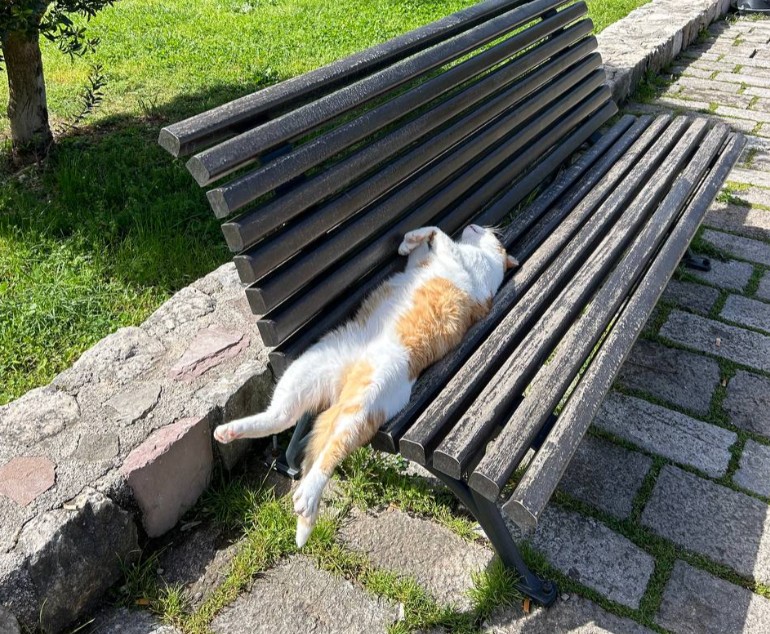
There are many reasons to visit Kotor. You can come for the dramatic mountains surrounding the Bay of Kotor, spend hours wandering through the narrow medieval streets of the Old Town, climb up to San Giovanni Fortress for one of the best views in Montenegro, or simply sit in a small square with a coffee and watch the city go by. But there is something else you are almost guaranteed to notice during your first few minutes in Kotor: cats.
They are sitting on windowsills, sleeping on warm stone steps, disappearing into little courtyards and casually walking through the middle of the Old Town as if they have somewhere much more important to be. Some are friendly and will happily come over to you, while others will look at a group of tourists taking photographs and continue sleeping without the slightest interest in what is happening around them.
After spending some time in Kotor, it becomes difficult to think about the city without thinking about its cats. They are not simply animals that happen to live in the streets; they have become such a recognizable part of Kotor that you will find them represented on souvenirs, postcards and artwork throughout the Old Town. There is even a small museum dedicated entirely to cats.
Why are there so many cats in Kotor?
The connection between Kotor and cats goes back much further than modern tourism. Kotor has been an important port on the Adriatic for centuries, and cats were traditionally valued on ships and in port towns because they helped control mice and rats around food supplies and cargo. As ships came and went, cats became a familiar part of life in the city, and generations later they remain everywhere in the historic centre.
There are also plenty of places for cats to live in Kotor. The Old Town is a maze of old stone buildings, staircases, courtyards and quiet corners, with countless sheltered spaces where a cat can disappear when it wants to be left alone. The warm Mediterranean climate certainly does not hurt either.

Over time, however, the cats became more than practical working animals. They became part of the character of the city itself. Today, visitors often arrive in Kotor knowing that they are going to see cats, and for many people they become one of the most memorable parts of the trip.
You will also hear some rather more dramatic stories about the relationship between Kotor and its cats. One popular legend claims that cats helped save the city from the plague, while another says that they helped local people survive difficult periods by providing food or protecting supplies. These stories are charming, but they should be treated as legends rather than established historical facts. Even the Kotor Cats Museum points out that some of these popular stories have no reliable historical basis.
Where can you find cats in Kotor?
The best thing about looking for cats in Kotor is that you do not really have to look very hard. Unlike many tourist attractions, there is no particular place you have to visit and no special tour you need to book. Simply walking through the Old Town is usually enough.
I found some of the most interesting cats in the quieter streets away from the busiest tourist routes. They seemed to have their own favourite corners, with some choosing sunny steps and others hiding underneath tables or sitting in doorways. The closer you look, the more of them you start noticing.
And this is probably one of the reasons the cats are so entertaining. At first you might see one or two and think that there are quite a lot of cats in Kotor. After walking around for an hour, you suddenly realize that you have been surrounded by them the entire time.
Some of them are particularly comfortable around people. They will sit beside a café terrace while tourists photograph them, walk between people’s feet or simply stretch out in the middle of a busy square. Others are much more cautious and disappear as soon as someone comes too close.
The Cats Museum in Kotor
For a city with such a strong connection to cats, it is perhaps not surprising that Kotor has its own cat museum. The Cats Museum is located inside the Old Town and contains a collection of historical objects connected with cats, including postcards, prints, photographs, books, posters and other pieces of cat-related memorabilia.
It is a small museum rather than a major attraction that requires hours to explore, which actually makes it quite easy to include in a day of sightseeing. You can spend some time looking around the collection and then continue exploring the Old Town, where you will immediately encounter the real-life subjects of the museum.
The museum is also a reminder that the relationship between Kotor and cats is not simply a modern Instagram trend. Cats have been represented in art, literature and everyday objects for centuries, and their presence in Kotor has gradually become part of the city’s cultural identity.
The cats are part of Kotor’s personality
What I liked most about the cats in Kotor was that they did not feel like a tourist attraction. Nobody had to create a special experience for visitors because the cats were already there, doing exactly what cats normally do.
They sleep when they want to sleep, disappear when they want to disappear and occasionally decide that a particular tourist looks interesting enough to approach. They are completely indifferent to the fact that someone might have travelled thousands of kilometres to visit the city and is now standing in front of them with a camera.
That makes the experience feel much more authentic than a typical tourist attraction. You are not coming to Kotor specifically to see a cat show or visit an animal park. You are simply exploring the city, and the cats happen to be part of the experience.
For me, this is one of those small details that can completely change the way you remember a destination. Years later, you may not remember every church or every street you walked through, but you will probably remember the cat that was sleeping on the steps, the one that followed you for half a street, or the one that looked as though it owned an entire square.
And in Kotor, that last possibility is actually quite believable.
 admin
admin