

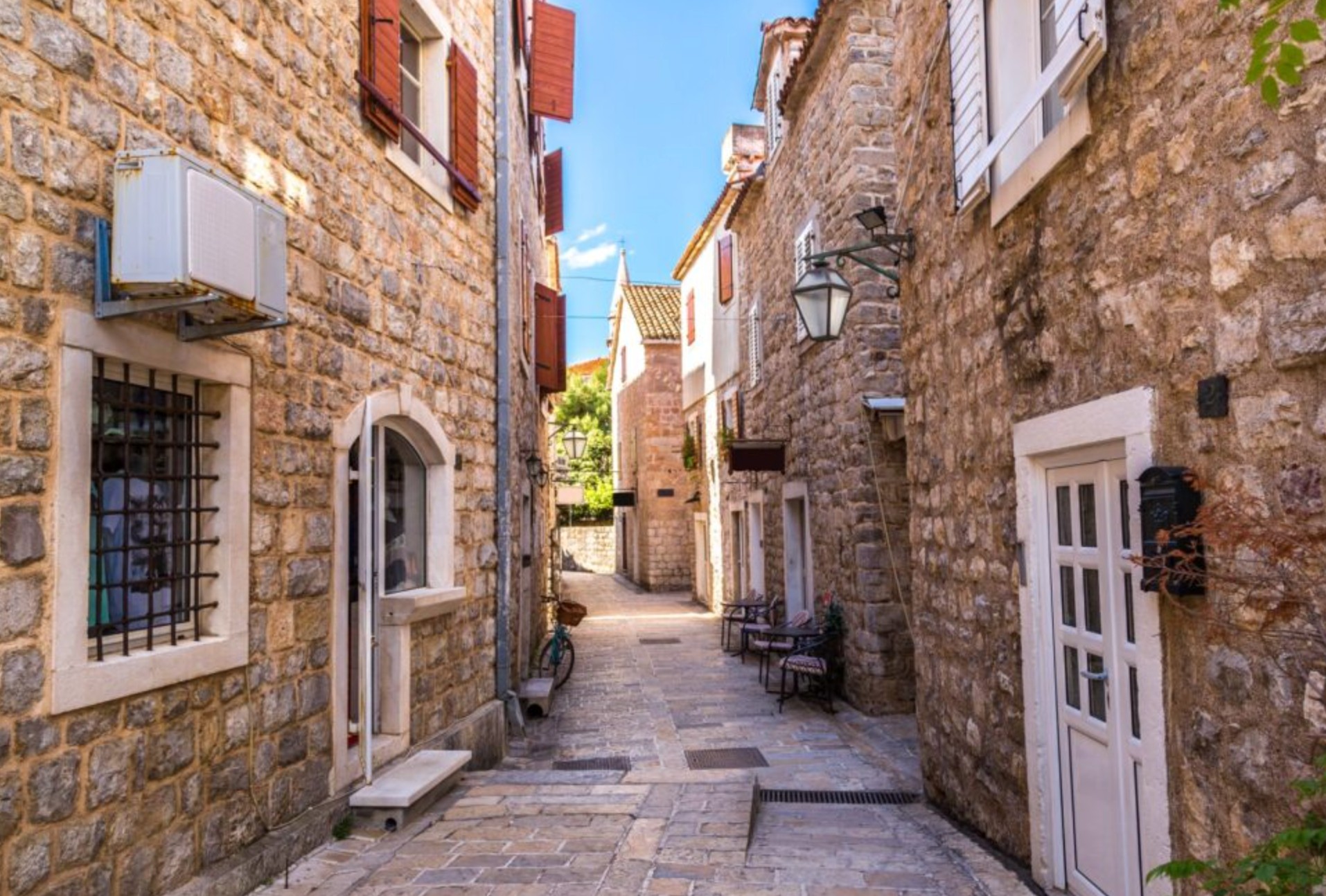
Budva old town is a compact medieval walled settlement on a small peninsula, with narrow stone streets, a hilltop citadel, and a handful of historic churches. You can walk across it in about ten minutes. The old town is open to visitors year-round, has no entry fee, and is the main tourist draw in Budva. Here is exactly what you will find inside, how to get there, and what you need to know before you go.
What Budva Old Town Actually Is
Budva old town, often called Stari Grad in Montenegrin, is the historic core of the city of Budva. It sits on a small peninsula that juts out into the Adriatic Sea, with the waterfront on three sides and the modern town wrapped around the landward side. The walled area covers roughly 2 hectares, which is about half the size of Kotor’s old town. The walls are intact and form a complete ring around the settlement, with towers at the corners and three main gates.
The settlement has been continuously inhabited since the 5th century BC, when it was established as a Greek trading post. It later passed to the Romans, Byzantines, Venetians, and Austrians. The Venetian influence is the most visible: the walls, gates, and much of the stonework date from the 15th to 18th centuries, when Budva was part of the Venetian Republic’s maritime empire. The town suffered severe damage in the 1979 earthquake and underwent a full restoration that took eight years. Most of what you see today is faithful reconstruction, not original, but it is well done and the overall character is intact.
The old town is small. You can walk from one side to the other in five minutes without stopping. There are no cars inside the walls, and the streets are narrow, paved with limestone slabs polished smooth by generations of foot traffic. The town is compact enough that you do not need a map — you will find the main sights by walking in any direction and letting the alleys guide you.
What to See Inside the Old Town
The Citadel is the most prominent feature. It sits at the highest point of the peninsula, at the southeastern corner of the walls. The fortress was built in the 15th century and expanded by the Austrians in the 19th century. The Citadel contains a small maritime museum with naval exhibits and a collection of amphorae from the Greek and Roman periods. The museum costs 3 euros to enter. The real reason to visit is the view from the outer terraces, which give you a 360-degree panorama over the old town’s rooftops and across the coast.
Three churches are worth seeing inside the old town. The Church of Saint John the Baptist is the largest, built in the 7th century and rebuilt after the earthquake. It is on the eastern side of the main square and is open during the day. The Church of Saint Mary in Punta is smaller and older, with a Romanesque bell tower. The Church of the Holy Trinity is a small Orthodox church with an iconostasis and simple interior. All three are free to enter, though donations are appreciated at Saint John’s. None of them are exceptional enough to justify the trip on their own, but they are pleasant stops if you are already walking through.
The main square, called Trg Između Crkava or Square Between Churches, is the central open space. It is surrounded by cafes and restaurants, and it is the most crowded part of the old town. The square is not large — you could fit about 150 people in it before it becomes uncomfortable. In July and August, it reaches that capacity by 11 AM.
Walking the city walls is an option if you want a different perspective. The walls are about 10 metres high and you can walk along the top of some sections. The entrance is near the Citadel and costs 3 euros. The walk takes about 15 to 20 minutes and gives you views over the sea and the adjacent beaches. The walls are narrow in places and have no handrails, so it is not recommended for those with a fear of heights.
The Surrounding Beaches
The old town is positioned between two beaches. Mogren Beach is on the southern side, in a small cove separated from the old town by a low hill. It is accessible via a walkway that follows the cliff from the old town’s southern gate. The walk takes about five minutes. Mogren is the most famous beach in Budva, with clear water and small pebbles. It is also the most crowded, with sunbeds and umbrellas packed tightly along the shoreline. A full day at Mogren in peak season is a tight fit, and the atmosphere is not particularly relaxing.
Slovenska Beach is on the northern side and is significantly longer, stretching about 1.6 kilometres along the coast. It is a purpose-built resort beach with hotels, restaurants, and water sports facilities. The sand is coarse pebble, not fine sand, and the water is clean. The beach is busier than Mogren because it is longer and more accessible, but it also has more space. The south end of Slovenska Beach, closest to the old town, is the most active section with the most amenities.
How to Get to Budva Old Town
Budva is well connected by road. The drive from Tivat Airport takes about 20 minutes and costs 18 to 22 euros by taxi. The drive from Podgorica Airport takes about an hour and costs 50 to 60 euros. Buses from Tivat cost 5 to 7 euros and take 25 minutes. Buses from Podgorica cost 10 to 15 euros and take 1.5 hours. If you are coming from Kotor, the bus takes 30 minutes and costs 3 to 5 euros. From Herceg Novi, the bus takes 1 hour and costs 6 to 8 euros.
If you are driving yourself, parking is the main challenge. The old town has no car access, and the surrounding streets have limited on-street parking. There are several paid parking lots within a five- to ten-minute walk: the largest is at the Slovenska Beach end of the waterfront and costs 10 to 15 euros per day in summer. Private parking spots near the old town can cost up to 25 euros per day. Most visitors park at the larger lot and walk to the old town. The walk takes ten minutes along the waterfront promenade.
Buses drop you off at the main bus station, which is about 500 metres from the old town. From the bus station, you walk straight toward the coast and turn left at the waterfront. The old town wall will become visible after about ten minutes.
Where to Stay and Eat
Accommodation inside the old town is limited. There are a few boutique hotels and guesthouses within the walls, but most are small and expensive. A double room inside the walls in July or August costs 100 to 200 euros per night. A comparable room outside the walls, on the waterfront or near Slovenska Beach, costs 70 to 150 euros. If you want to stay near the action, the old town is the most convenient base, but you will pay a premium for the location.
Eating inside the old town is a mixed experience. The restaurants on the main square and along the waterfront are overpriced and aimed at tourists. A mediocre pizza costs 12 to 15 euros, and a seafood main course costs 25 to 40 euros. The quality is often average, and the portions are smaller than in Kotor or other places in Montenegro. The better dining options in Budva are outside the walls, along the waterfront toward Slovenska Beach, where the restaurants serve local customers and the prices are 20 to 30 percent lower.
For drinks, the old town is lively. There are a handful of small bars tucked into the alleyways, and they are open late in summer. A local Nikšićko beer costs 3 to 4 euros, and a glass of wine costs 4 to 7 euros. The bars are more expensive than the local tavernas in the rest of Budva, but you are paying for the atmosphere.
The Honest Downsides
The first downside is the crowds. In July and August, the old town is packed from 10 AM to 8 PM. The narrow streets are shoulder-to-shoulder, the cafes are full, and the atmosphere becomes frantic. The old town is so small that the density can feel overwhelming. The cruise ship days are the worst: on days when a large ship docks at the Kotor port, the old town floods with day-trippers, and the experience becomes stressful rather than enjoyable. If you only have the option of visiting in July or August, go early in the morning and leave before 10 AM, or arrive after 5 PM when the day-trippers have started to leave.
The second downside is the overdevelopment. The old town is surrounded by a dense ring of modern hotels and apartment buildings that tower above the historic walls. From inside, you can still enjoy the medieval atmosphere, but from the waterfront or the surrounding beaches, the old town looks dwarfed and overshadowed by the modern development. This is a trade-off: Budva is a working resort town with a small old town attached to it, not a preserved historic city like Kotor.
The third downside is the noise. The old town is within earshot of the nightlife venues that line the waterfront. In summer, the music from the outdoor bars and clubs plays until 1 or 2 AM, and the sound carries through the narrow streets. If you want to sleep early, do not stay in the old town or on the waterfront. The adjacent beaches are also noisy during the day, with speakers and music playing from every beach bar.
When to Visit
The best months to visit Budva old town are May, June, and September. The weather is warm enough for outdoor dining and walking, the crowds are manageable, and the sea is swimmable. July and August are the worst months for crowds and heat, with temperatures reaching 35 degrees and no shade inside the old town. The shoulder seasons of April and October are also good, but the weather is cooler and the sea is only swimmable for the hardy. The old town is fully accessible year-round, and in winter it is quiet and pleasant, but most restaurants and shops have reduced hours.
The old town is open to visitors every day, with no entry fee. The Citadel, the maritime museum, and the wall walks have separate entry fees of 3 euros each. The opening hours for the Citadel and museum are 8 AM to 8 PM in summer and 9 AM to 5 PM in winter.
How to Visit in One Day
If you only have one day, arrive early. Start with a walk around the inside of the walls, following the waterfront side first and then working your way through the central streets. Visit the Citadel for the view, then walk through the main square and look at the churches. A thorough walk of the old town takes about 1.5 hours at a relaxed pace. After that, walk to Mogren Beach for a swim, and have lunch at one of the beachfront restaurants along the path to the beach. In the late afternoon, walk back to the old town for a drink on the main square as the light changes.
Frequently Asked Questions
Is there an entry fee for Budva old town?
No. The old town is free to enter. You pay only for the Citadel, the maritime museum, and the wall walk, each costing 3 euros.
How long do I need to see Budva old town?
One and a half hours is enough to walk through the main streets, see the churches, and visit the Citadel. If you include the museum and the wall walk, plan for 2.5 hours. Most visitors combine the old town with a visit to Mogren Beach, which adds another 2 to 3 hours.
Is Budva old town worth visiting?
Yes, but it is not a destination on its own. It is best combined with the beaches or the nightlife. If you are in the Bay of Kotor for the history and scenery, Kotor’s old town is superior. If you are looking for a beach resort with some historic character, Budva is a good choice.
How do I get from Kotor to Budva old town?
Take the bus from Kotor’s main bus station. The trip takes 30 minutes and costs 3 to 5 euros. Buses run every 30 to 60 minutes. A taxi costs 25 to 40 euros and takes 25 minutes.
Is it better to stay in Budva old town or outside?
Stay outside for lower prices and less noise. The rooms inside the old town are expensive and loud at night because of the nearby bars. The waterfront hotels just outside the walls offer easier access, better views, and similar prices to the old town.
What is the best time of day to visit Budva old town?
Early morning, before 9 AM, or late afternoon, after 5 PM, to avoid the crowds and the heat. The light at sunset is the best for photos, but the streets will still be busy until after dinner.
Budva old town is a compact and photogenic historic core that is best experienced as part of a broader beach stay. It does not rival Kotor in scale or atmosphere, and it is more crowded and more developed than its reputation suggests. But the churches, the Citadel, and the view from the walls are enjoyable, and the proximity to the beaches makes it a convenient stop. Visit early, stay for a few hours, and spend the rest of your time on the coast.
 admin
admin