

Snow-capped peaks of the Greater Caucasus drop into lush green valleys, ancient stone towers dot remote highland villages, and the Black Sea crashes against a coastline that feels more Mediterranean than post-Soviet. Georgia squeezes glaciers, semi-desert, subtropical beaches, and Europe’s oldest wine region into a country smaller than Ireland, and the result is a visual chaos that somehow works perfectly.
You can drive from Tbilisi’s ornate balconies to the alpine meadows of Svaneti in half a day—but the winding mountain roads and Soviet-era infrastructure mean you’ll want to budget more time than the kilometers suggest. Nature lovers, history buffs, and anyone who wants Europe’s most underrated mountain scenery without the Alpine price tags will find exactly what they’re looking for here.
Planning Your Trip to Georgia
- Best time to visit: Best Time to Visit Georgia
- Travel insurance: SafetyWing or World Nomads
- Accommodation: Booking.com or Hostelworld
- Getting around: Renting a Car in Georgia
- Stay connected: Airalo or Holafly eSIM
- Flights: Skyscanner
The Most Beautiful Places in Georgia
Tbilisi
Colorful balconies with intricate wooden carvings lean over cobblestone streets while modern glass bridges and a futuristic cable car span the Mtkvari River—old and new collide on every corner.
Tbilisi is Georgia’s sprawling, chaotic, utterly charming capital. The Old Town is a labyrinth of narrow alleys, sulfur bathhouses with brick domes, and 19th-century architecture that survived both Soviet modernization and decades of neglect. The Narikala Fortress watches over the city from a hilltop, while the Sameba Cathedral—one of the largest Orthodox churches in the world—dominates the skyline from the opposite bank.
Wander through the Old Town’s winding streets, soak in the sulfur baths of Abanotubani, and take the cable car up to Narikala Fortress for the best view over the city. The Dry Bridge Market is perfect for Soviet-era souvenirs, and Fabrika—a repurposed Soviet sewing factory—is now a hipster hub with bars, art spaces, and hostels.
Honest note: Tbilisi’s traffic is relentless, the sidewalks are uneven, and summer temperatures regularly hit 35°C. The city rewards patience and comfortable shoes—it’s not a polished European capital, and that’s exactly its appeal.
(Best for: culture seekers and urban explorers)
Kazbegi (Stepantsminda)
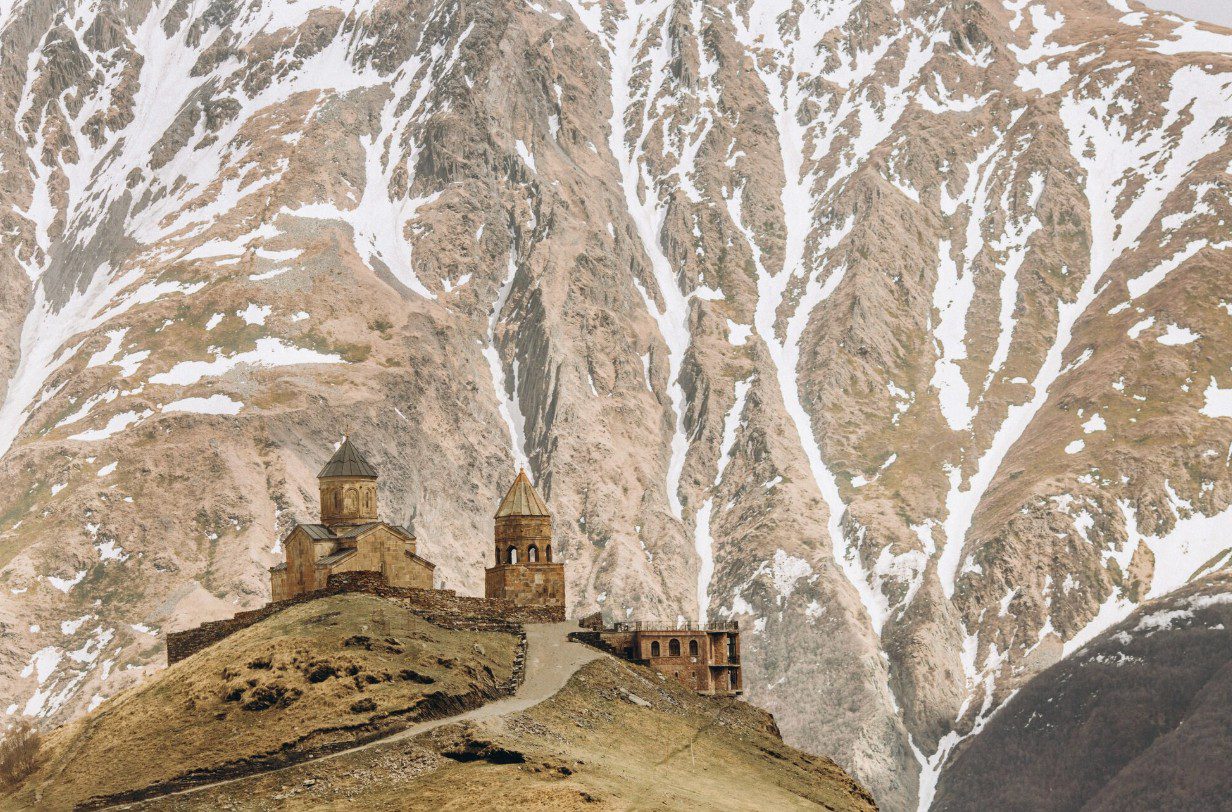
The Gergeti Trinity Church sits alone on a hilltop at 2,170 meters, with Mount Kazbek’s 5,033-meter snow-covered peak looming directly behind it—a composition so perfect it looks staged.
Kazbegi, officially Stepantsminda, is the main settlement in the northern Caucasus, just a few kilometers from the Russian border. The town itself is a functional mountain base, but its surroundings are what draw visitors: the Terek River valley, the Dariali Gorge, and the iconic Gergeti Trinity Church, a 14th-century monastery that’s become Georgia’s most photographed landmark.
Hike the steep 1.5-hour trail from Stepantsminda to Gergeti Trinity Church—or take a jeep if you’re short on time. From the church, continue to the Gergeti Glacier for a full-day trek. The Georgian Military Highway that connects Tbilisi to Kazbegi is an attraction in itself, with stops at the Ananuri Fortress and the Russia-Georgia Friendship Monument. The Gudauri ski resort, 30 kilometers south, offers winter sports and panoramic views.
Honest note: Kazbegi is the most accessible mountain destination in Georgia, which means it’s also the most crowded. In July and August, the church trail feels like a queue, and accommodation books out weeks in advance. Go in May or September for clear skies and thinner crowds.
(Best for: hikers and photographers)
Svaneti — Mestia and Ushguli
Medieval stone towers—some over 1,000 years old—rise from a green valley floor, and beyond them, the glaciers of Mount Shkhara glint in the sun like a wall of ice.
Svaneti is Georgia’s most remote and dramatic region, a high-mountain territory where time has moved slower than anywhere else in the Caucasus. Mestia is the regional hub, a small town with a museum, a few hotels, and a handful of stone towers that hint at what lies deeper in the valley. Ushguli, 50 kilometers east, is Europe’s highest continuously inhabited village at 2,200 meters, and its cluster of defensive Svan towers is a UNESCO World Heritage site. Mount Shkhara, at 5,193 meters, is Georgia’s highest peak and dominates the skyline.
Hike the multi-day Mestia–Ushguli trail—50 kilometers of alpine meadows, river crossings, and villages that feel frozen in the Middle Ages. From Ushguli, trek to the Shkhara Glacier for an up-close view of the mountain’s north face. The Svaneti Museum of History and Ethnography in Mestia houses icons, manuscripts, and artifacts that explain the region’s fierce independence.
Honest note: Getting to Svaneti is a commitment. The drive from Tbilisi takes eight hours, and from Kutaisi about six. The road is winding and sometimes treacherous. The hiking season is short—June to September—and even then, weather can shut down trails without warning.
(Best for: serious hikers and adventure travelers)
Mtskheta
Two rivers—the blue-green Aragvi and the muddy Mtkvari—converge below a hilltop monastery, and from that monastery, you can see the entire valley where Christianity took root in Georgia.
Mtskheta was the capital of the Kingdom of Iberia from the 3rd century BC to the 5th century AD, and it remains the spiritual heart of Georgia. The Historical Monuments of Mtskheta—Jvari Monastery, Svetitskhoveli Cathedral, and Samtavro Monastery—are UNESCO World Heritage sites. Jvari, perched on a hill at the confluence of the two rivers, dates to the 6th century and offers the best views in the region. Svetitskhoveli, in the town center, is a 11th-century cathedral that’s the second-largest church in Georgia and the traditional burial site of Christ’s robe.
Visit Jvari Monastery first—the view over Mtskheta and the river confluence is unmissable. Then descend to Svetitskhoveli Cathedral to see the “Life-Giving Pillar” and the 11th-century frescoes. Samtavro Monastery, a short walk away, has a 4th-century church and the grave of Saint Nino, who converted Georgia to Christianity.
Honest note: Mtskheta is a day-trip from Tbilisi—30 minutes by marshrutka—but it gets packed with tour buses between 10 a.m. and 3 p.m. The town itself is small and touristy; the real value is in the churches and the views, not the souvenir shops.
(Best for: history lovers and pilgrims)
Kutaisi
Georgia’s second city sprawls along the Rioni River with a 11th-century cathedral at its center and a decaying Soviet grandeur that somehow feels more authentic than any restored old town.
Kutaisi is one of Georgia’s oldest cities, and it served as the capital of the Kingdom of Colchis in ancient times. The Bagrati Cathedral, built in 1003, and the Gelati Monastery, founded in 1106, are both UNESCO World Heritage sites—though Bagrati’s reconstruction has been controversial. Kutaisi is also the gateway to western Georgia’s natural wonders: the Prometheus Cave, Martvili Canyon, and Okatse Canyon are all within an hour’s drive.
Visit Bagrati Cathedral for its hilltop views over the city, then drive 10 kilometers to Gelati Monastery to see its 12th-century mosaics and the tomb of King David IV. The Kutaisi Market is one of the best in Georgia for fresh produce and churchkhela—the traditional candle-shaped candy made from grape juice and nuts. From Kutaisi, take day trips to Prometheus Cave and Martvili Canyon.
Honest note: Kutaisi is more of a base than a destination. The city itself is gritty, the sights are scattered, and Bagrati’s modern reconstruction has divided opinion—some find it ruined, others find it restored. Either way, it’s worth a day.
(Best for: culture seekers and nature explorers)
Batumi
Palm trees line a 7-kilometer seaside promenade, a futuristic Alphabet Tower rises above the water, and two steel figures—Ali and Nino—move toward each other and then apart in an endless mechanical dance.
Batumi is Georgia’s Black Sea resort, a city that feels more like a Mediterranean playground than a post-Soviet port. The Batumi Boulevard stretches for 7 kilometers along the coast, past palm trees, sculptures, and the iconic Ali and Nino moving statue. The Batumi Cathedral of the Mother of God is a Gothic Revival church with stunning stained glass, and the Batumi Botanical Garden, perched on a hill north of the city, offers panoramic sea views.
Walk the Batumi Boulevard at sunset to see the Ali and Nino statue in motion. Visit the Batumi Cathedral and the nearby Piazza—a European-style square with a musical fountain. The Batumi Botanical Garden is a 20-minute drive from the city center and well worth the trip for its collection of subtropical plants and Black Sea views. The Old Town has a few cobbled streets and 19th-century buildings that survived the Soviet era.
Honest note: Batumi is Georgia’s Vegas—glitzy, slightly tacky, and absolutely packed in July and August. The beaches are pebbly, not sandy, and the water is warm but not crystal-clear. If you want a quiet coastal escape, look elsewhere. If you want boulevards, nightlife, and a very un-Georgian seaside experience, Batumi delivers.
(Best for: beach travelers and nightlife seekers)
Vardzia
A cliff face on the Mtkvari River is riddled with hundreds of caves, some stacked 16 levels high, and inside those caves, a 12th-century monastery once housed 2,000 monks.
Vardzia is a cave monastery complex carved into the Erusheti mountain in southern Georgia. Built during the reign of Queen Tamar in the 12th century, the complex included churches, living quarters, refectories, and a sophisticated irrigation system. The Church of the Dormition, the spiritual center of the complex, is still intact and houses 12th-century frescoes, including a rare depiction of Queen Tamar herself. At its peak, the monastery could accommodate up to 2,000 people.
Explore the cave complex—the 16 levels are connected by tunnels, stairways, and hidden passages. The Church of the Dormition is the highlight, with its well-preserved frescoes of the Virgin Mary and Queen Tamar. Walk the steep path to the bell tower for a view over the Mtkvari valley. The site is open from 10 a.m. to 6 p.m. daily, and entry costs about 15 GEL.
Honest note: Vardzia is remote—a three-hour drive from Tbilisi or two hours from Borjomi. The caves are spectacular, but the site is sprawling and mostly empty; it’s a ruin, not a living monastery. The climb is steep, and there’s little shade, so bring water and a hat.
(Best for: history lovers and photographers)
Uplistsikhe
An entire city was carved into a sandstone cliff over 3,000 years ago, and its rock-hewn streets, theaters, and temples still bear the marks of the civilizations that built them.
Uplistsikhe is one of the oldest urban settlements in Georgia, dating back to the early Iron Age around 1,000 BC. The cave city was carved into a rocky plateau on the left bank of the Mtkvari River, about 10 kilometers east of Gori. The complex includes over 150 caves and structures, including pagan temples, Christian churches, a theater, and a central hall with a smoke hole that was used for religious ceremonies. The site was a major political and religious center until it was sacked by the Mongols in the 13th century.
Walk through the rock-hewn streets and explore the caves—the central hall with its pillar and smoke hole is the most impressive. The small basilica church, built in the 10th century, has a simple but moving interior. The view from the top of the plateau overlooks the Mtkvari River and the surrounding countryside. Allow two to three hours for a full visit.
Honest note: Uplistsikhe is fascinating but requires imagination—the caves are bare, and most of the original structures are gone. There’s little shade and no cafes inside the site, so bring water. Gori, the nearest town, is Stalin’s birthplace, which adds an odd historical layer to the visit.
(Best for: history buffs and archaeology enthusiasts)
Kakheti Wine Region — Sighnaghi and Telavi
Vineyards stretch across the Alazani Valley as far as the eye can see, and beyond them, the snow-capped peaks of the Greater Caucasus form a wall between Georgia and Russia.
Kakheti is Georgia’s wine heartland, the region where the country’s 8,000-year-old winemaking tradition is most alive. Sighnaghi is the region’s poster child—a fortified hilltop town with cobblestone streets, red-tiled roofs, and panoramic views over the Alazani Valley. Telavi is the administrative capital, a functional town that’s the base for exploring the region’s wineries and monasteries. The Alaverdi Monastery, founded in the 6th century, still produces wine using traditional qvevri methods, and the Tsinandali Estate is a 19th-century aristocratic winery with a beautiful garden.
Visit Sighnaghi for the views and the vibe—climb the city walls for a panorama of the Caucasus. Take a wine tasting at a local winery—Pheasant’s Tears in Sighnaghi is a popular stop, or visit the Alaverdi Monastery for a more traditional experience. The Kvareli Wine Tunnel is a massive underground cellar aged in Soviet-era tunnels. The Tsinandali Estate has a museum and a garden worth an hour of your time.
Honest note: Sighnaghi is beautiful but has become a tourist trap—the town is essentially one long souvenir street, and the wineries are geared toward bus tours. For a more authentic experience, skip the big wineries and find a family cellar in the villages. The region is also brutally hot in July and August.
(Best for: wine lovers and romantics)
Prometheus Cave
Massive stalactites and stalagmites fill cave halls the size of cathedrals, and underground rivers flow through chambers illuminated in neon blue and green—a subterranean light show that’s part nature, part theme park.
Prometheus Cave, near Kutaisi, is one of the largest and most impressive caves in Georgia. The cave system stretches over 11 kilometers, with 22 halls open to the public. The highlights include a 20-meter-high stalactite, an underground river that you can boat on, and a concert hall with natural acoustics that actually hosts classical performances. The cave is accessible via a well-lit walking path, and the lighting design—controlled by the government—is dramatic but tasteful.
Walk the 1.5-kilometer path through the cave—the route takes about an hour. The underground river boat ride is optional but worth it for the views of the cave’s formations from the water. Entry costs about 20 GEL, and the boat ride is extra. The cave is open daily from 10 a.m. to 6 p.m.
Honest note: Prometheus Cave is a well-oiled tourist operation—the path is smooth, the lighting is stage-managed, and the tours run like clockwork. It’s impressive but feels sanitized compared to wilder cave experiences. The boat ride is short and touristy. Still, for a first-time caver, it’s spectacular.
(Best for: families and casual explorers)
Martvili Canyon
Emerald-green water rushes through a narrow limestone canyon, and a historic stone walkway—built by a 19th-century prince—lets you stand right above the churning water.
Martvili Canyon, in western Georgia, is a natural gorge carved by the Abasha River. The canyon is about 700 meters long, and visitors walk along a circular path that passes through the Dadiani family’s historic walkway—built in the 19th century by the local princely family. The canyon’s most striking feature is its milky turquoise water, which contrasts sharply with the white limestone walls. The water comes from underground springs and is remarkably clear.
Walk the 700-meter circular trail, which takes about an hour. Take a boat ride through the canyon for the best views—the boat glides under overhanging rock formations and past small waterfalls. The boat ride is short but worth the extra 10 GEL. The canyon is open daily, and entry costs about 15 GEL.
Honest note: Martvili is beautiful but small—you can see everything in 90 minutes. The water is cold, even in summer, and the boat ride is brief. The canyon is also a day-trip destination, so it gets busy in the middle of the day. Come early or late for better light and fewer people.
(Best for: nature lovers and photographers)
Borjomi-Kharagauli National Park
Pine forests carpet the slopes of the Lesser Caucasus, mineral water springs bubble up from the ground, and hiking trails stretch for over 100 kilometers through some of Georgia’s least-visited wilderness.
Borjomi-Kharagauli National Park is the largest national park in Georgia, covering over 80,000 hectares in the Lesser Caucasus. The park is best known for its mineral water springs—Borjomi water is famous across the former Soviet Union—but the real draw is the network of hiking trails that wind through forests, across ridges, and past alpine meadows. The park has nine marked trails ranging from easy day hikes to multi-day treks. The most popular is the 12-kilometer trail to the Lomismta Monastery, which offers views over the entire park.
Hike the Lomismta trail—it takes about 4-5 hours round trip and is well-marked. Visit the Borjomi Mineral Water Park, a beautiful green space in the town center where you can drink the water straight from the spring. The park is open daily, and entry to the mineral water park costs about 2 GEL. The national park’s visitor center can provide trail maps and advice.
Honest note: The national park is vast and poorly signposted in places. The trails are not always well-maintained, and the weather can change rapidly in the mountains. This is not a casual stroll—it’s real hiking, and you need proper gear. The mineral water park in Borjomi, by contrast, is a tourist attraction with manicured paths and busloads of visitors.
(Best for: serious hikers and nature lovers)
Tusheti National Park — Omalo
A remote mountain village at 1,880 meters, accessible only by a treacherous pass that’s closed for half the year, and surrounded by some of the wildest, least-visited landscapes in the Caucasus.
Tusheti is Georgia’s wildest region, a high-mountain territory in the northeast that feels like the edge of the world. Omalo is the main village, perched at 1,880 meters and accessible only via the Abano Pass—a road that’s often closed from October to June due to snow. The region is protected as Tusheti National Park, and its landscape is a mix of alpine meadows, deep valleys, and rugged peaks. The village of Dartlo, with its stone towers, is even more remote than Omalo.
Hike or take a 4×4 from Omalo to the surrounding villages—Dartlo is the most scenic, with its restored stone towers and views over the valley. Trek to the Keselo Fortress, a cluster of defensive towers above Omalo that offers a panoramic view of the entire region. The national park has over 11 marked trails, ranging from easy walks to multi-day treks. The best time to visit is July to September, when the pass is open and the weather is stable.
Honest note: Tusheti is not for casual travelers. The road to Omalo is terrifying—narrow, unpaved, and clinging to cliff edges. The pass closes with the first snow, and the region is cut off for half the year. Accommodation is basic, and there are no ATMs. But if you make it, you’ll have one of the most remote experiences in Europe.
(Best for: off-the-grid adventurers and serious hikers)
Ananuri Fortress
A 17th-century fortress with two churches and a defensive tower sits on the shores of the Zhinvali Reservoir, and the turquoise water reflects its stone walls perfectly on a calm day.
Ananuri is a medieval fortress complex on the Georgian Military Highway, about 70 kilometers north of Tbilisi. The complex includes two churches: the Church of the Assumption, which dates to 1689, and the smaller Church of the Virgin, which is older. The fortress was the seat of the Aragvi dukes, who controlled the region from the 13th to the 18th centuries. The Zhinvali Reservoir, created by a Soviet-era dam, now surrounds the fortress on three sides, creating a striking contrast between the ancient stone and the blue water.
Climb the defensive tower for the best view over the reservoir and the surrounding mountains. Visit the Church of the Assumption to see the remains of 17th-century frescoes. Walk around the outer walls for more views. The site is a popular stop on the Tbilisi–Kazbegi route, and it’s free to enter.
Honest note: Ananuri is small and can be seen in 30 minutes. It’s also a bus-tour stop, so expect crowds in the middle of the day. The reservoir is beautiful, but the water level fluctuates, and the shoreline isn’t always accessible. That said, it’s a perfect photo stop on the way to Kazbegi, not a destination in itself.
(Best for: photographers and road-trippers)
Okatse Canyon
A suspension bridge swings over a 200-meter-deep gorge, and from its swaying planks, you can see a waterfall that drops directly into the canyon floor below.
Okatse Canyon, near Kutaisi, is a natural gorge carved by the Okatse River. The main attraction is the “Kinchkha Waterfall”—a 100-meter cascade that’s visible from a viewing platform. But the real draw is the suspension bridge that crosses the canyon—a 780-meter-long structure that offers heart-pounding views of the gorge below. The canyon’s trail is about 2.5 kilometers long and takes roughly 1.5 hours to complete.
Walk the trail to the suspension bridge—the bridge is the highlight, and the views from the middle are unforgettable. The Kinchkha Waterfall is a 15-minute walk from the bridge. The canyon is open daily, and entry costs about 10 GEL. The trail is well-maintained and suitable for most fitness levels.
Honest note: Okatse is less developed than Martvili and feels more authentic—but the trail is steep in places, and the bridge is not for the faint-hearted. The canyon is also less accessible than Martvili; you’ll need a car or a tour. The waterfall is impressive but seasonal—it’s strongest in spring and early summer.
(Best for: adventure seekers and nature lovers)
Map of the Best Places to Visit in Georgia
[EDITOR: Insert embedded Google Map or screenshot with all 15 places pinned]
Tips for Visiting Georgia
Getting around: A rental car is strongly recommended for anything beyond Tbilisi—public transport between mountain destinations like Kazbegi, Svaneti, and Tusheti is limited or nonexistent. The coast and Kakheti are better served by marshrutkas, but a car gives you freedom to stop at viewpoints and wineries.
How many days: Ten to fourteen days will cover the highlights comfortably—four for Tbilisi and Mtskheta, three for Kazbegi and the Military Highway, three for Svaneti, and the rest for Kakheti, Kutaisi, and the western canyons. Any less and you’ll be rushing.
Best time to visit: May–June and September–October for Tbilisi and the coast—the weather is warm, the crowds are thinner, and the hiking trails are accessible. July and August are brutally hot in the lowlands, but the mountains are pleasant. Winter (December–March) is for skiing in Gudauri, Bakuriani, and Mestia.
Where to base: Tbilisi for the east and central regions, Kutaisi for the west, Mestia for Svaneti, and Stepantsminda for Kazbegi. Don’t try to do the mountains and the coast from one base—the distances are deceptive, and the roads are slow.
Insider tip: The Georgian Military Highway from Tbilisi to Kazbegi is spectacular, but the road through the Rikoti Pass to Kutaisi is equally scenic and far less crowded. Take the old road, not the new tunnel, if you want views of the Rioni Valley.
Frequently Asked Questions
What is the most beautiful place in Georgia? Svaneti is the answer for most travelers—the combination of medieval stone towers, alpine meadows, and glaciers is unlike anything else in Europe. But Tbilisi’s Old Town and the Gergeti Trinity Church are strong contenders depending on your preference for urban or mountain scenery.
What are the must-see places in Georgia for first-time visitors? First-timers should prioritize Tbilisi, Mtskheta, Kazbegi (with Gergeti Church), Svaneti (Mestia and Ushguli), and Kakheti. These five give you the full range of Georgia’s culture, history, mountains, and wine.
How many days do you need to see the best of Georgia? A minimum of ten days—four for Tbilisi and the east, three for Kazbegi and the Military Highway, and three for Svaneti. With two weeks, you can add Kutaisi, the western canyons, and Batumi.
What is the prettiest town in Georgia? Sighnaghi is the prettiest—its red-tiled roofs, cobblestone streets, and views over the Alazani Valley make it a photographer’s dream. But it’s very touristy. For a more authentic alternative, the village of Ushguli in Svaneti is equally beautiful and far more remote.
Is Georgia better than Switzerland for nature? Georgia offers similar alpine scenery at a fraction of the cost, but the infrastructure is far less developed. Trails are less maintained, lifts are fewer, and the weather is more unpredictable. If you want rugged, wild, and cheap nature, Georgia wins. If you want polished, predictable, and expensive nature, Switzerland does it better.
Georgia rewards travelers who embrace its chaos—the unreliable roads, the language barrier, the unpredictable weather. The coast is pleasant, the wine is excellent, and the cities are fascinating, but the mountains are where Georgia reveals its soul. If you’re the type who’d rather hike to a remote village than sip wine on a terrace, you’ll get the most out of this small but wildly varied country.
 admin
admin