

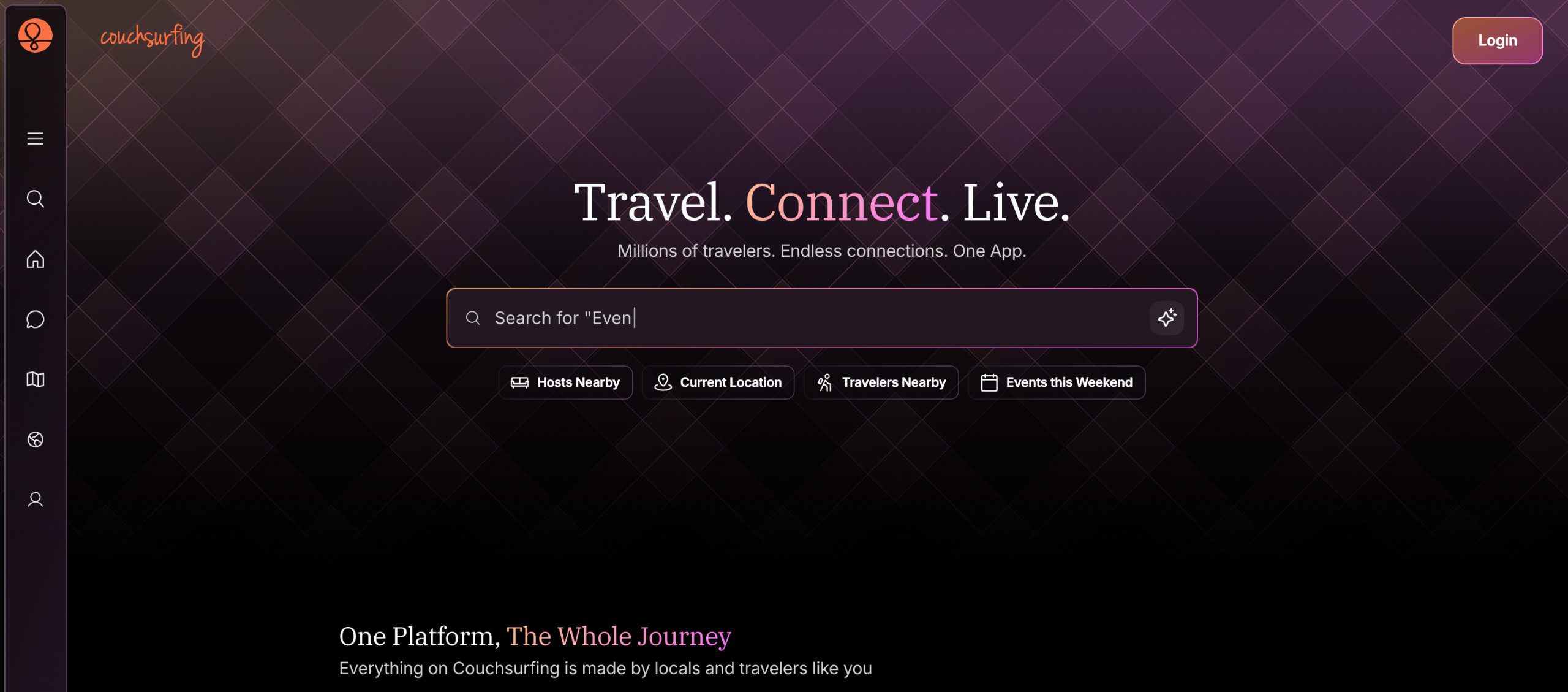
Couchsurfing still works in 2026, but it is no longer the simple “free place to stay” platform many travelers remember. Access now requires a paid membership in many markets, the platform was rebuilt in 2026, and finding the right host still takes time and effort.
For solo travelers who genuinely want to meet locals and are comfortable staying in someone else’s home, Couchsurfing can still be worth using. If your main goal is simply to find cheap, predictable accommodation, however, a hostel or budget hotel is usually easier.
The most important thing to understand is that Couchsurfing is a hospitality exchange, not a free hotel booking service. A host is never guaranteed, stays are based on mutual trust, and you should always have a backup plan.
What Is Couchsurfing?
Couchsurfing is a hospitality-exchange platform connecting travelers with locals. Members can offer travelers a couch, spare room or other place to sleep without charging for accommodation. The platform is also used to meet locals, attend events and find other travelers.
The idea became popular because it combined two things budget travelers often want: lower accommodation costs and actual interaction with people who live in the destination.
But Couchsurfing has changed considerably since its early years. It moved from its original non-profit ambitions to a for-profit structure in 2011, introduced mandatory contributions for many users in 2020, and launched a major platform rebuild in May 2026.

How Much Does Couchsurfing Cost in 2026?
Couchsurfing stays themselves are not supposed to be paid accommodation. Hosts should not charge travelers for sleeping at their home.
Access to the platform is different. Couchsurfing now operates through paid memberships rather than relying on advertising.
Pricing varies by country, platform and payment method. As of August 2026, the US App Store lists options including a $4.99 monthly contribution and a $19.99 annual contribution. Different contribution prices also appear in some markets, so check the actual amount shown in your account before subscribing.
The important change is that current Couchsurfing membership includes:
- Unlimited messaging.
- Unlimited stay requests.
- Hosting and staying with members.
- Communities.
- Events and meetups.
- Other core platform features.
This means older information claiming that paying members can only send a small number of host requests per week is no longer accurate.
Membership and Verification Are Not the Same Thing
Couchsurfing also offers Verification as a separate add-on. The US App Store currently lists Annual Verification at $29.99, although pricing can vary.
Verification is optional. You do not need a Verification Badge to use the full Couchsurfing platform once you have the required membership.
In 2026, Couchsurfing also changed what the badge means. A verified member must now complete government-issued ID verification. The process involves submitting an accepted ID, such as a passport, national identity card or driver’s license, together with a short video selfie through the app.
So when comparing Couchsurfing costs, do not automatically add membership and verification together. Verification is an optional trust signal rather than a requirement for requesting a stay.
What Changed on Couchsurfing in 2026?
In May 2026, Couchsurfing launched a new platform rebuilt from the ground up rather than simply redesigning the old interface.
The rebuilt service introduced or expanded several social features:
- Communities built around cities and shared interests.
- Introductions between members.
- Hangouts for meeting nearby members.
- Curated Events for finding local activities.
- Improved host-search tools.
- Filters for recently active members and members with references.
The changes matter because Couchsurfing is trying to position itself as more than a place to request a free bed. The social side of the platform is now a much bigger part of the product.

The rebuild was not completely smooth. Couchsurfing itself acknowledged problems after launch, including login issues, missing references, subscription problems and general performance bugs. The company reported rolling out fixes throughout the weeks following the launch.
That distinction is important. Some negative reviews online describe versions of the platform that have since been updated, while some problems may still affect individual users. Check recent app reviews rather than assuming a complaint from several years ago describes the current product.
Is Couchsurfing Still Free?
Not in the way travelers historically used the word “free.”
You may need to pay to access Couchsurfing, but hosts do not charge you for the actual stay. That makes the model different from Airbnb, hostels and hotels.
However, paying for membership does not buy accommodation.
You can subscribe, send requests and still receive no suitable hosting offer for your dates. Popular cities, short-notice trips, holiday periods and incomplete profiles can all make finding a host more difficult.
This is the biggest mistake first-time users can make: treating a Couchsurfing subscription as if it were an accommodation reservation.
Who Is Couchsurfing Best For in 2026?
Solo Travelers
Couchsurfing makes the most sense for solo travelers who actively want social interaction.
Staying with a local immediately gives you someone to talk to and potentially a very different introduction to a destination than checking into an anonymous hotel room.
Hangouts, Communities and Events also mean you can use Couchsurfing without staying in someone’s home. That can be useful if you already have accommodation but want to meet people.
Budget Travelers
Couchsurfing can reduce accommodation spending, but it should not be treated as a guaranteed budget strategy.
Suppose you are planning a seven-day trip. You might find hosts for several nights, one night or none at all. A host may also only be available for part of your stay.
The safer budgeting approach is to calculate your trip as if you will need paid accommodation. Any confirmed Couchsurfing stays then reduce that cost rather than being necessary for the trip to remain affordable.
Travelers Who Want Local Interaction
This remains Couchsurfing’s strongest use case.
If you would happily pay for your own accommodation but specifically want conversations, shared meals and time with locals, Couchsurfing can still offer something a standard hotel booking does not.
On the other hand, sleeping in a stranger’s home is not the only way to add local interaction to a trip.
You can stay in a hostel or hotel and use Couchsurfing Hangouts, local events, walking tours, food experiences or small-group activities instead. You can also browse local tours and activities on Klook or compare experiences on KKday.
This costs more than hospitality exchange, but it provides a confirmed place to sleep while keeping some of the social and experiential side of travel.
When Couchsurfing Is Probably Not Worth It
Couchsurfing is a poor fit if accommodation certainty is your priority.
You may prefer a hostel, guesthouse or hotel if:
- You are arriving very late at night.
- You need guaranteed accommodation before traveling.
- You want privacy.
- You need a specific location.
- You are traveling with substantial luggage.
- You need to work remotely from your room.
- You do not want to spend time sending personalized requests.
- You mainly want to save money rather than meet your host.
The last point matters especially.
Hospitality exchange works because both sides are choosing to spend some part of the stay interacting with another person. If your ideal arrangement is arriving late, sleeping for free and leaving without much conversation, a cheap hostel is often a better match.
Couchsurfing vs Hostel: Which Is Better?
Neither is automatically better. They solve different problems.
Choose Couchsurfing If:
- Meeting locals is one of your main reasons for traveling.
- You are comfortable staying in a private home.
- Your dates are somewhat flexible.
- You have time to read profiles and send thoughtful requests.
- You understand that a host is never guaranteed.
Choose a Hostel If:
- You need guaranteed accommodation.
- You are booking at the last minute.
- You want to meet other travelers rather than primarily locals.
- You prefer having reception or staff available.
- You want to choose your neighborhood precisely.
- You are uncomfortable sleeping in a stranger’s home.
A hostel can actually be the better choice for some solo travelers because social hostels make it relatively easy to meet people without relying on a single host.
You can then add local experiences separately. For example, a food tour, cooking class or small-group day trip found through Klook or KKday can provide some of the local interaction travelers often hope to get from Couchsurfing.
Is Couchsurfing Safe?
Couchsurfing involves staying in the private home of someone you did not previously know, so it requires a different level of judgment than checking into a conventional hotel.
The platform currently provides references, identity verification, blocking and reporting tools, emergency-contact settings and a Trust and Safety team. Those features help users assess potential hosts and guests, but they cannot remove all risk.
Before confirming a stay:
- Read the entire host profile rather than only looking at the rating or number of references.
- Read recent references carefully.
- Look for references from travelers with a similar profile to yours.
- Keep initial communication inside Couchsurfing.
- Discuss sleeping arrangements before arriving.
- Confirm who else lives in the home.
- Know the approximate location before you commit.
- Tell someone where you will be staying.
- Keep enough money available to leave and book alternative accommodation.
A Verification Badge can add another piece of information because it now represents government-ID verification, but it should not replace reading references and communicating with the host.
Couchsurfing for Solo Female Travelers
Solo female travelers should apply the same basic precautions with additional attention to boundaries, sleeping arrangements and backup accommodation.
Couchsurfing’s current safety guidance specifically suggests that women can consider female hosts, families or couples if that makes them more comfortable. It also recommends reading what other women have written in references and making sure someone else knows where you are staying.
A practical approach is to shortlist hosts with substantial recent references and communicate clearly before confirming anything.
Ask questions that affect your actual comfort:
- Will I have a separate room or sleep in a shared space?
- Who else will be in the apartment?
- Can I come and go independently?
- How do I get back to the accommodation at night?
- Are there any expectations about spending time together?
If the answers make you uncomfortable, choose another host or paid accommodation.
And if something feels wrong after you arrive, you are not obligated to stay simply because a host agreed to accommodate you. Leave and arrange another place to sleep.
Always Have a Backup Plan
This is probably the most important practical rule for using Couchsurfing.
Do not arrive in a destination with no money for accommodation because you expect someone on Couchsurfing to host you.
Plans change. Hosts get sick, work late, have family emergencies or simply realize they cannot accommodate someone after all.
Before arriving, know:
- Which hostels or hotels are available nearby.
- How much a last-minute room is likely to cost.
- How you would reach that accommodation at night.
- Whether you have mobile data and enough battery to book it.
This is particularly important for solo travelers and late-night arrivals.
Can You Use Couchsurfing Without Staying With a Host?
Yes, and this may actually be one of the most useful ways to use Couchsurfing in 2026.
The platform includes Hangouts, Communities and Events, so you can book your own accommodation while still using Couchsurfing to meet locals and travelers.
This approach removes much of the uncertainty around accommodation.
For example, you could:
- Stay in a hostel and join a Couchsurfing Hangout.
- Book your own room and attend a local Couchsurfing event.
- Use Communities to ask practical questions before arriving.
- Meet a Couchsurfing member for coffee without staying at their home.
If no relevant Couchsurfing event exists for your dates, paid local activities are another option. Klook and KKday both let you search destination-specific activities, tours and experiences.
They are not Couchsurfing alternatives in the accommodation sense, but they can solve the other part of the problem: finding interesting things to do when you do not have a local host showing you around.
Best Couchsurfing Alternatives in 2026
If you like hospitality exchange but do not want to pay for Couchsurfing, several community-based alternatives remain active.
Couchers.org
Couchers.org is one of the clearest direct alternatives to Couchsurfing. It describes itself as free forever, community-led and non-profit.
As of 2026, the platform reports more than 56,000 members across more than 180 countries and has moved out of beta into its first full version.
Its main disadvantage is scale. A smaller network means fewer potential hosts in many destinations, so you may need to send requests earlier or combine it with another platform.
BeWelcome
BeWelcome is another established hospitality-exchange network. It is volunteer-run, non-profit and free to use.
The platform currently reports around 230,000 members. Travelers can search for hosts, arrange stays or simply meet locals without staying overnight.
BeWelcome can be a useful choice if the non-commercial side of hospitality exchange matters to you, although activity levels vary significantly between destinations.
Trustroots
Trustroots is a non-profit, open-source hospitality-exchange community designed around sharing, hosting and meeting travelers.
It remains free to use and is especially associated with independent travel communities.
Like other smaller Couchsurfing alternatives, its main trade-off is that there may be fewer active hosts in the specific destination you are visiting.
Couchsurfing vs Couchers vs BeWelcome vs Trustroots
Couchsurfing’s main advantage is scale and a mature ecosystem of profiles, references, Hangouts and local activity.
Its main disadvantage is that access is now commercial and requires a membership in many markets.
Couchers, BeWelcome and Trustroots offer free hospitality exchange with non-profit or community-led models. The trade-off is a smaller pool of potential hosts.
For travelers who genuinely like hospitality exchange, there is little reason to restrict yourself to one platform.
You can create thoughtful profiles on two or three services and see where the active community is strongest for your particular destination.
How to Get More Couchsurfing Requests Accepted
Your success depends heavily on how you use the platform.
Start with a complete profile. A blank account asking for a free bed gives a host very little reason to trust you.
Then avoid sending identical copy-and-paste requests to dozens of people.
A useful request should explain:
- Who you are.
- Why you are visiting the city.
- Your exact dates.
- Why you chose that particular host.
- What kind of trip you are taking.
- Anything important about your schedule.
You do not need to write an essay. You do need to show that you actually read the person’s profile.
References also matter. If you are new and have none, try attending events, meeting community members or hosting before relying on Couchsurfing for an important trip.
Frequently Asked Questions
Is Couchsurfing still a thing in 2026?
Yes. Couchsurfing remains active in 2026 and launched a major rebuilt platform in May. Members can find hosts, attend events, join Communities and use Hangouts to meet people nearby.
Is Couchsurfing free in 2026?
The accommodation provided by hosts is free, but Couchsurfing access requires paid membership for many users. Prices depend on country and platform. The US App Store currently lists a $4.99 monthly contribution and a $19.99 annual option.
Do you have to pay extra for Couchsurfing verification?
Verification is separate from membership and optional. The US App Store currently lists Annual Verification at $29.99. Pricing can vary. In 2026, earning the Verification Badge requires government-issued ID verification.
Can Couchsurfing hosts charge money?
No. Couchsurfing is not supposed to operate as paid accommodation. If a host asks you to pay for the stay, Couchsurfing’s current safety guidance says you should decline and report the profile.
Is Couchsurfing safe for solo female travelers?
There is no accommodation platform that can guarantee personal safety. Couchsurfing provides references, verification and reporting tools, but solo female travelers should still research hosts carefully, keep someone informed of their location and maintain a backup accommodation plan.
What is the best free Couchsurfing alternative?
Couchers.org, BeWelcome and Trustroots are all free alternatives worth checking. Which one works best depends heavily on how active the community is in the destination you are visiting.
What happens if I cannot find a Couchsurfing host?
Book conventional accommodation rather than depending on an unconfirmed host. You can still use Couchsurfing to meet people through Hangouts or Events, or find local tours and experiences through activity platforms such as Klook and KKday.
Is Couchsurfing worth paying for?
It can be if you genuinely want hospitality exchange and expect to use the social features as well as host stays. It is less compelling if your only objective is finding the cheapest possible accommodation with minimal effort.
Bottom Line: Is Couchsurfing Worth It in 2026?
Couchsurfing is still worth considering in 2026, but not because it offers guaranteed free accommodation.
Its real value is access to people.
If you are a solo traveler who enjoys meeting locals, is comfortable staying in private homes and is prepared to spend time finding the right host, the membership fee can be reasonable.
If you primarily want an inexpensive place to sleep, a hostel is more predictable. If you want complete privacy, book your own room. And if what you really want is local interaction rather than free accommodation, you can combine your own accommodation with Couchsurfing events, Hangouts or organized local experiences.
The best strategy is not to build an entire trip around finding a free couch. Use Couchsurfing as one travel tool among several, choose hosts carefully and always keep enough money and flexibility for a backup place to stay.
Couchsurfing membership, verification details, platform features and alternative-platform information were checked in August 2026. Prices and features can change, so confirm the current terms before paying for a membership or planning a stay.