

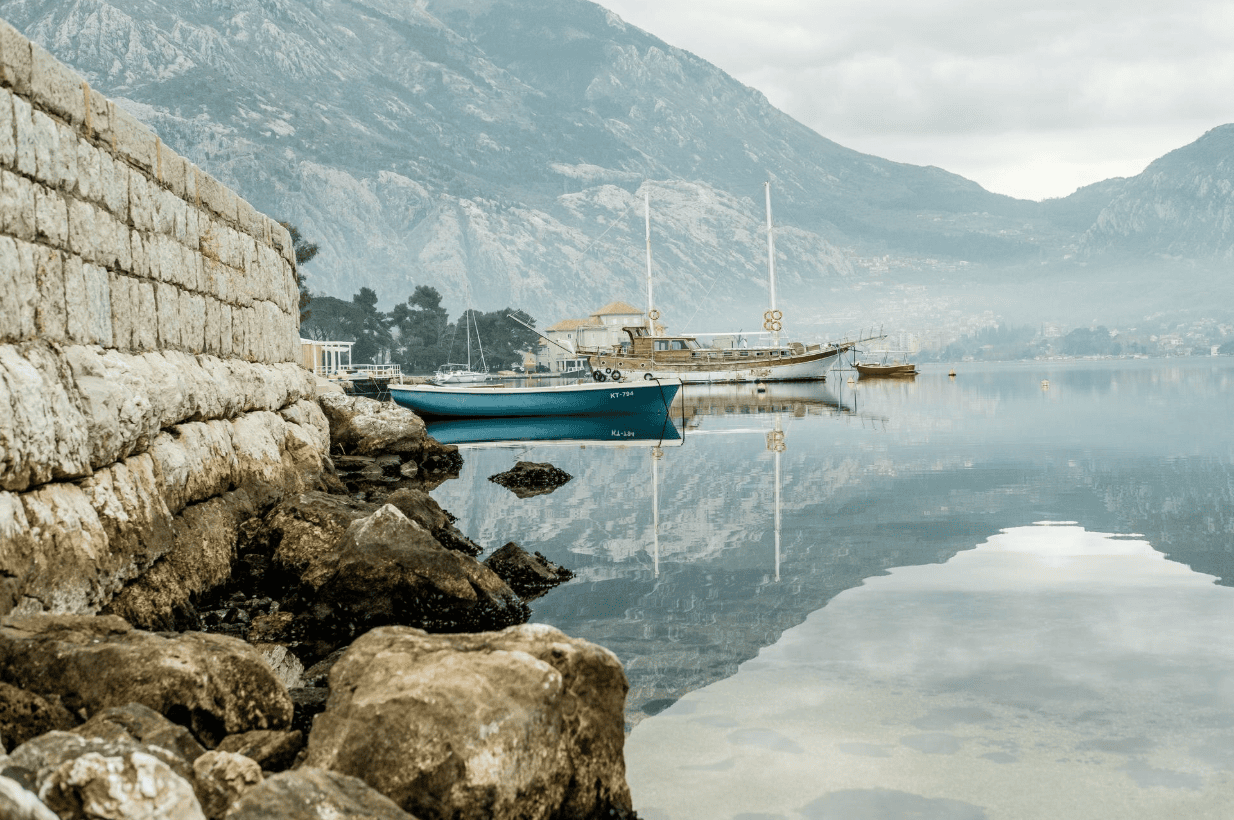
Montenegro packs an Adriatic coastline, medieval walled towns, and UNESCO-listed mountain canyons into an area smaller than Connecticut. You can drive across the country in about three hours, but the winding mountain roads mean distances take longer than they look on a map. This is a place where you can swim in the sea and hike through glacial lakes in the same day—if you’re willing to log some serious driving hours.
Nature lovers, history buffs, and anyone who wants Croatia-level scenery without the crowds will find exactly what they’re looking for here. The most beautiful places in Montenegro aren’t just postcard views—they’re experiences that stick with you long after you’ve left.
Planning Your Trip to Montenegro
- Best time to visit: Best Time to Visit Montenegro
- Travel insurance: SafetyWing or World Nomads
- Accommodation: Booking.com or Hostelworld
- Getting around: Renting a Car in Montenegro
- Stay connected: Airalo or Holafly eSIM
- Flights: Skyscanner
The Most Beautiful Places in Montenegro
Kotor
Terracotta rooftops crowd against a limestone cliff face while the Bay of Kotor shimmers below—this is what greets you when you climb the 1,360 steps to the fortress above the old town.
Kotor’s Stari Grad is a UNESCO-listed medieval maze of cobblestone lanes, Venetian palaces, and cafe-strewn squares wedged between brooding mountains and the bay. The city walls date back to Venetian rule, and the 12th-century Cathedral of Saint Tryphon stands as the town’s spiritual anchor.
Walk the city walls for the full panorama, explore the Maritime Museum, and get lost in the labyrinth of narrow streets. The fortress climb is non-negotiable—start early to beat the heat and the cruise ship crowds. Inside the old town, visit St. Luke’s Church and the 16th-century Sea Gate with its winged lion of St Mark.
Honest note: From June to September, cruise ships disgorge thousands of passengers daily, and the old town can feel more like a theme park than a medieval city. Come in May or October for the same beauty with half the people.
(Best for: history lovers and photographers)
Perast
Two tiny islands float just offshore, and the smaller one—Our Lady of the Rocks—was built entirely by hand, stone by stone, by local sailors over centuries.
Perast is a sleepy baroque town on the Bay of Kotor, about 12 kilometers from Kotor. Its main claim to fame is the man-made islet of Our Lady of the Rocks, created by sailors who found an icon of the Virgin Mary on a rock and began sinking stones and old ships to build an island around it. The church on the island dates to 1632 and holds over 60 paintings by 17th-century artist Tripo Kokolja.
Take a water taxi from Perast’s waterfront—it’s a 5 to 10-minute ride. Inside the church, see the baroque altar, the museum, and the famous tapestry embroidered with human hair by a woman waiting for her sailor husband to return. Afterward, wander Perast’s quiet streets and have lunch at a waterfront restaurant.
Honest note: The island gets crowded with tour groups from Kotor between 10 a.m. and 3 p.m. Go early morning or late afternoon for soft light and fewer people.
(Best for: history buffs and romantics)
Budva
Red-tiled roofs spill down a small peninsula to the Adriatic, and from the Citadel’s ramparts you can see the entire coastline curve toward the horizon.
Budva’s Stari Grad is one of the oldest settlements on the Adriatic coast, a pedestrian-only labyrinth of Venetian architecture enclosed by medieval defensive walls. The Citadel (Kaštel) sits at the highest point of the old town, a 15th-century fortress with a small maritime museum and library inside.
Climb the Citadel for 360-degree views, then explore the three churches in the central square: St. John’s Church with its tall bell tower, Santa Maria in Punta, and the Orthodox Holy Trinity Church with its red-and-white stone patterns. Look for the “Secret Gates” that lead directly from the stone alleys to small pebble beaches right under the city walls. The Mogren Beach is a short walk from the old town.
Honest note: Budva is Montenegro’s party town. In July and August, the beaches are packed, and the nightlife is loud. If you’re after quiet coastal charm, Perast or Herceg Novi will serve you better.
(Best for: beach travelers and nightlife seekers)
Herceg Novi
Instead of grand squares, you’ll find steep stone staircases connecting hidden courtyards, colorful houses, and fortresses that seem to grow straight out of the Adriatic.
Perched at the entrance to the Bay of Kotor, Herceg Novi was founded in 1382 and shaped by Venetian, Ottoman, Spanish, and Austro-Hungarian rule. The town is known as the “city of a thousand steps”, and its two main fortresses—Forte Mare and Kanli Kula—offer panoramic views of the bay and the open sea.
Climb Kanli Kula, the highest fortress, for spectacular views over the Bay of Kotor. Visit Forte Mare at the seafront, especially at sunset. Wander the old town’s cobblestone streets, see the Clock Tower in Belavista Square, and walk the long waterfront promenade. The Savina Monastery, a peaceful complex surrounded by Mediterranean greenery, is also worth a stop.
Honest note: Herceg Novi requires a good pair of walking shoes and some stamina—the stairs are relentless. But that’s exactly why it’s quieter than Kotor or Budva.
(Best for: travelers who want coastal beauty without the crowds)
Cetinje
Tucked in a green valley at the foot of Mount Lovćen, this quiet town feels more like a provincial European capital than a Balkan mountain settlement.
Cetinje is Montenegro’s historic royal capital, founded in the 15th century as a strategic mountain stronghold. The Cetinje Monastery, built between 1701 and 1704, houses the Right Hand of John the Baptist and a fragment of the True Cross—relics that draw pilgrims from across the Orthodox world. King Nikola’s Palace, a modest royal residence turned museum, offers a look into the country’s final monarchy. The 19th-century embassy buildings along the main promenade add a touch of faded grandeur.
Visit the Cetinje Monastery, then walk to the Biljarda (Billiard Palace), the former residence of Petar II Petrović Njegoš. Explore the National Museum and the old embassy buildings. The town is also the launching point for Lovćen National Park.
Honest note: Cetinje is not a coastal town—it’s inland, about 30 kilometers from Kotor. The mountain air is cooler, and the vibe is more contemplative. Some travelers find it underwhelming after the drama of the coast; others find it the most authentic place in Montenegro.
(Best for: history lovers and culture seekers)
Ulcinj
An ancient walled town that feels more Ottoman than Venetian, overlooking a 12-kilometer stretch of sandy beach that’s the longest on the Montenegrin coast.
Ulcinj’s Old Town is one of the oldest urban complexes on the Adriatic, and it bears the marks of centuries of Ottoman rule—arched doorways, small mosques, and a distinct eastern Mediterranean feel. The town was heavily damaged in the 1979 earthquake, and parts of the old town remain residential and somewhat dilapidated, which is part of its rough charm.
Wander the Old Town’s stone streets, visit the 15th-century Balsic Tower for panoramic Adriatic views, and see the Sailors’ Mosque. The 12-kilometer Great Beach (Velika Plaža) is a long stretch of fine sand—unusual for Montenegro’s mostly pebble coastline. Rozafa Fortress, just outside town, offers spectacular views over the city and Lake Shkodra.
Honest note: Ulcinj is more rugged and less polished than Kotor or Budva. The old town is partly in ruins, and the beaches are crowded in July and August. But if you want a taste of Montenegro’s Ottoman past and the best sandy beach in the country, this is your spot.
(Best for: beach lovers and offbeat travelers)
Durmitor National Park
Forty-eight limestone peaks and eighteen glacial lakes—the “Mountain Eyes”—spread across a UNESCO World Heritage landscape that feels like the Alps but without the crowds or the lift tickets.
Durmitor National Park in northern Montenegro is the country’s outdoor playground. The park’s centerpiece is Black Lake (Crno Jezero), a glacial lake at 1,416 meters elevation, just a short hike from the town of Žabljak. The highest peak, Bobotov Kuk, stands at 2,523 meters and offers a challenging trek with panoramic views across the Balkan peninsula.
Hike the easy 3.5-kilometer loop around Black Lake, or tackle Bobotov Kuk for the ultimate summit view. The Durmitor Ring is an 85-kilometer scenic drive through high-altitude passes and traditional shepherd villages. In winter, the park offers skiing and snowshoeing.
Honest note: Durmitor is only accessible by car—public transport from the coast is limited to nonexistent. The hiking season runs from June to September; outside these months, snow blocks many trails and roads.
(Best for: hikers and nature lovers)
Tara River Canyon
Europe’s deepest canyon drops 1,300 meters from the rim to the emerald river below, and you can see it all from the arch of the Đurđevića Tara Bridge.
The Tara River Canyon, located within Durmitor National Park, is the deepest canyon in Europe and the second deepest in the world. The Tara River is known as the “Tear of Europe” for its crystal-clear water, and it’s one of the last unpolluted rivers on the continent. The 366-meter Đurđevića Tara Bridge spans the canyon with a dramatic S-curve.
White-water rafting is the main event—trips range from gentle scenic floats to adrenaline-pumping Class IV rapids. Walk or drive across the Đurđevića Tara Bridge for the classic viewpoint. The bridge also has a zipline if you’re feeling brave. Half-day to full-day trips are available from Žabljak.
Honest note: The bridge and rafting operations are busy in July and August. The drive from the coast to the canyon takes about three hours, so this is a full-day commitment. Rafting is seasonal—the river is too cold and high outside May to September.
(Best for: adventure travelers)
Skadar Lake
Lotus flowers bloom in the shallows, herons lift off from ruined fortresses, and the largest lake in the Balkans stretches into the horizon, half of it in Albania.
Skadar Lake National Park is a wetland paradise straddling the Montenegro-Albania border. The lake is dotted with islets, fishing villages, and medieval monasteries accessible only by boat. The most famous is Kom Monastery, perched on Odrin Hill and accessible only by traditional wooden boat. The lake is also a birdwatcher’s dream, with over 260 species of birds.
Take a boat tour from Virpazar—the launching point for most lake excursions. The 3-hour tour to Kom Monastery includes travel along narrow canals, a visit to the 15th-century monastery, and a swim in the lake. See the ruins of Lesendro fortress among the water chestnuts, and keep an eye out for the water lilies that blanket the shallows.
Honest note: The lake is beautiful, but the mosquitoes are relentless in summer. Bring strong repellent. The boat tours are touristy, but they’re the only way to see the monasteries—there are no roads to most of them.
(Best for: nature lovers and birdwatchers)
Lovćen National Park
From the summit of Jezerski Vrh, you can see both the Adriatic Sea and the mountains of Albania—a view that sums up Montenegro’s dramatic geography in a single glance.
Lovćen National Park sits above the Bay of Kotor, protecting the mountain that gives Montenegro its name (Crna Gora means “black mountain”). The park’s centerpiece is the Njegoš Mausoleum on Jezerski Vrh at 1,655 meters, the highest mausoleum in the world. Petar II Petrović Njegoš, Montenegro’s beloved prince-bishop and poet, is buried here.
Climb the 461 granite steps to the mausoleum entrance—the walk is steep but the view is worth it. The mausoleum entry costs €8. The Kotor–Cetinje road through Lovćen offers better views than the main highway and takes only 30 minutes longer—drive this route instead of the tunnel. Plan on three to four hours for the visit.
Honest note: The climb is tough, especially in summer heat. Bring water and go early. The road to the park is narrow and winding, but it’s in good condition—much better than the old road to Ostrog.
(Best for: hikers and history buffs)
Biogradska Gora National Park
Trees up to 100 meters tall and over 300 years old crowd around a glacial lake so still it mirrors the sky perfectly.
Biogradska Gora is one of Europe’s last remaining primeval forests. The park’s centerpiece is Biogradsko Lake, a glacial lake surrounded by ancient beech and pine trees. The park is quieter and less visited than Durmitor, making it a hidden refuge for nature lovers.
Walk the easy 5-kilometer path around the lake—it takes about two hours. Rent a kayak for €5 per hour and paddle the lake. The entrance fee is €3 per person to drive up to the lake. Visit in April for a winter wonderland before the tourist season starts.
Honest note: The park facilities are limited—there’s a small tourist center with rentals, but little else. The road to the lake is unpaved in places. Come for the peace, not the amenities.
(Best for: nature lovers seeking solitude)
Ostrog Monastery
A gleaming white monastery appears to grow out of a near-vertical cliff face 900 meters above the Zeta valley—and the faithful, some of them barefoot, climb the steep road to reach it.
Ostrog Monastery is the most important site in Montenegro for Orthodox Christians, attracting up to a million visitors annually. The Upper Monastery was built in 1665 within two large caves, seemingly impossibly carved into the rock. It houses the fabric-wrapped bones of Saint Basil of Ostrog, a 17th-century bishop. The Lower Monastery, 2 kilometers below, has the Holy Trinity Church with vivid frescoes from 1824.
Visit the Upper Monastery to see the cave chapels and the saint’s relics. Walk the 3 kilometers from the Lower Monastery to the Upper Monastery—many pilgrims do it barefoot. Stop at the natural spring behind the Lower Monastery for cold, sweet water.
Honest note: Dress code is strictly enforced—long trousers or skirts and covered shoulders are required. The old road to the monastery is terrifyingly narrow and poorly maintained; take the excellent road through Danilovgrad instead. There’s no direct public transport—tour buses from the coast cost €20 to €30.
(Best for: pilgrims and culture seekers)
Stari Bar
An abandoned medieval town sits among olive groves, its ruins telling the story of a place that was once a crossroads for empires and now belongs to the birds and the wild thyme.
Stari Bar is the ruined old town of Bar, abandoned after the 1870s and never fully rebuilt. The site is a fascinating archaeological treasure, with remnants of Byzantine, Venetian, and Ottoman rule. A 17th-century customs building houses a small museum explaining the site’s history. The ruins include a 13th-century Franciscan monastery, an 11th-century fortress, and a 17th-century Turkish bathhouse.
Follow the green arrows from the museum to see the major points. The 11th-century fortress offers much-photographed views over the olive groves and mountains. The ruins are spread out, so wear sturdy shoes and allow two to three hours. The views from the fortress are some of the best in the region.
Honest note: Stari Bar is ruins—there’s no shade, no cafes inside the site, and limited signage. Bring water and a hat. The site is fascinating for history lovers but may feel like “just rocks” to others.
(Best for: history lovers and photographers)
Sveti Stefan
A narrow isthmus connects a tiny island to the mainland, and on that island, stone houses with red-tiled roofs cluster together like they’ve been there since the 15th century—because they have.
Sveti Stefan is a 15th-century fishing village turned luxury resort, now part of the Aman hotel group. The island is connected to the mainland by a narrow causeway, and its stone exteriors have been preserved while the interiors are now exclusive suites. Marilyn Monroe, Elizabeth Taylor, and Yugoslav President Tito all stayed here.
Walk along the promenade and the beach to admire the island from the mainland—the view is the main attraction. The observation deck by the road offers the best photo opportunity. Sit in a café overlooking the isthmus and watch the sunset. The island itself is only accessible to Aman Hotel guests.
Honest note: You can’t go onto the island unless you’re staying at the Aman, which costs upwards of €1,000 per night. The view from the mainland is beautiful, but it’s just a view—there’s no “experience” beyond that. Some travelers find it overrated for this reason.
(Best for: luxury travelers and photographers)
Žabljak
This small mountain town sits at the doorstep of Durmitor National Park, and from its streets you can see the peaks that draw hikers from across Europe.
Žabljak is the main gateway to Durmitor National Park, a town of about 2,000 people at 1,456 meters elevation. It’s the highest town in the Balkans, and it serves as the base for exploring the park’s 48 peaks and 18 glacial lakes. The town has a handful of hotels, restaurants, and outdoor gear shops—enough to support the adventure tourism that keeps it alive.
From Žabljak, walk the easy 3.5-kilometer loop around Black Lake. The trailhead is a 3-kilometer walk from town. In winter, the town offers skiing and snowshoeing. The Durmitor Ring scenic drive starts from Žabljak. The town also has a few good restaurants serving hearty mountain food—try the lamb or the local cheese.
Honest note: Žabljak is a functional mountain town, not a picturesque Alpine village. The charm is in the access to the park, not the town itself. In winter, the town is cold and quiet; in summer, it’s the hub for hikers. Book accommodation well in advance during July and August.
(Best for: hikers and outdoor enthusiasts)
Tips for Visiting Montenegro
Getting around: A rental car is strongly recommended—public transport between mountain destinations is very limited. The coast has decent bus connections, but Durmitor, Biogradska Gora, and Ostrog require a car to reach efficiently.
How many days: Seven to ten days will cover the coast and mountains comfortably. Any less and you’ll be rushing. Four days for the coast (Kotor, Perast, Budva), three for the mountains (Durmitor, Žabljak, Tara), and a day each for Cetinje, Ostrog, and Skadar Lake.
Best time to visit: May–June and September–October for the coast—the weather is warm, the crowds are thin, and the cruise ships are fewer. June–September for Durmitor—the hiking trails are clear and the rafting is at its best.
Where to base: Kotor for the coast, Žabljak for the mountains. Don’t try to do both from one base—the drive is three hours each way, and you’ll spend more time in the car than at the sights.
Insider tip: The Kotor–Cetinje road through Lovćen offers better views than the main highway and takes only 30 minutes longer. Skip the tunnel and take the scenic route—you won’t regret it.
Frequently Asked Questions
What is the most beautiful place in Montenegro? Kotor’s old town and the Bay of Kotor are the most iconic, but Durmitor National Park and the Tara River Canyon offer equally stunning landscapes. It depends on whether you prefer coastal medieval charm or alpine wilderness.
What are the must-see places in Montenegro for first-time visitors? First-timers should prioritize Kotor, Perast, the Bay of Kotor boat trip, Durmitor National Park, and the Tara River Canyon. These five give you the full range of Montenegro’s coastal and mountain beauty.
How many days do you need to see the best of Montenegro? A minimum of seven days—four for the coast and three for the mountains. With ten days, you can add Cetinje, Ostrog Monastery, and Skadar Lake without rushing.
What is the prettiest town in Montenegro? Perast is often called the prettiest—its two islets, baroque architecture, and quiet streets make it more photogenic than bustling Kotor. But Kotor has more to do, so it depends on your priorities.
Is Montenegro better than Croatia for nature? Yes, if you want mountains and canyons. Croatia’s coast is more developed, but Montenegro’s interior—Durmitor, Tara, Biogradska Gora—offers wilderness that Croatia can’t match. The coast has fewer islands but the mountains are world-class.
Montenegro rewards travelers who are willing to drive, to climb, and to get up early. The coast is spectacular, but the mountains are where the country reveals its soul. If you’re the type who’d rather hike to a viewpoint than lounge on a beach, you’ll get the most out of this small but mighty country.
 admin
admin