

Snow-capped Mount Ararat looms over the Ararat Plain like a guardian of biblical proportions, ancient stone monasteries cling to cliff edges as if they grew there, and the pink-hued capital hums with a cafe culture that feels distinctly European. Armenia packs all of this into a country smaller than the state of Maryland, and the result is a density of beauty that rivals anywhere in the Caucasus. You can drive from the capital to the Georgian border in about six hours, but the winding mountain roads, Soviet-era infrastructure, and the sheer number of sights mean you will want to take your time. History buffs, hikers, wine lovers, and anyone seeking Europe’s most underrated destination will find exactly what they are looking for here.
The Most Beautiful Places in Armenia
Yerevan
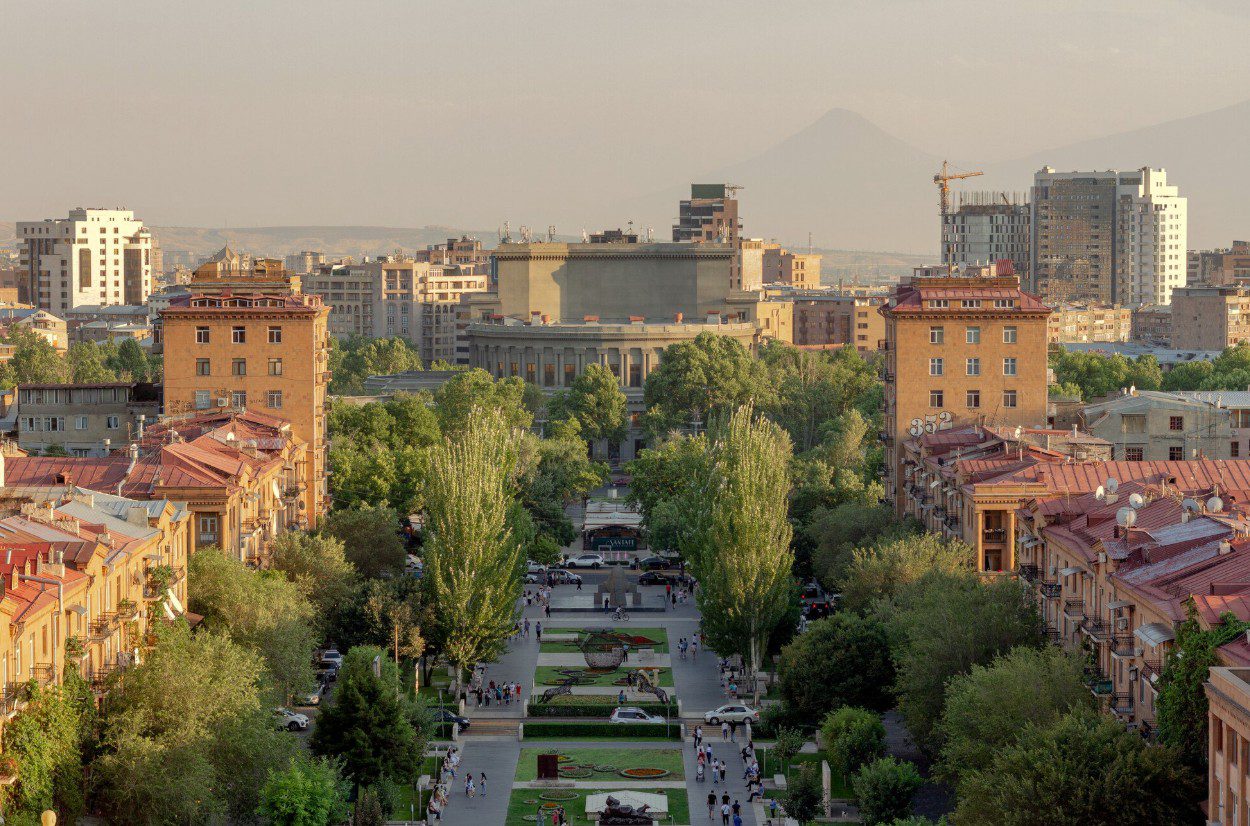
Buildings made of rose- and coral-hued tuff stone glow pink in the afternoon light, and from the top of the Cascade’s 572 steps, you can see Mount Ararat floating on the horizon like a mirage.
Yerevan is one of the world’s oldest continuously inhabited cities, founded in 782 BC. The city center, designed by architect Alexander Tamanyan, is a masterpiece of pink tuff architecture that earned Yerevan the nickname “the Pink City”. The Cascade Complex is a massive travertine staircase adorned with sculptures by Botero and other international artists, topped with a panoramic view of the city and Mount Ararat. Republic Square, with its musical fountains and grand government buildings, is the heart of the capital.
Climb the Cascade for the best view of the city and Mount Ararat—on a clear day, the biblical mountain seems close enough to touch. Visit the Matenadaran, which houses one of the world’s largest collections of ancient manuscripts with over 23,000 texts. Explore Republic Square at night for the fountain light show, and wander through the Vernissage weekend market for Soviet-era collectibles and handmade crafts. The Tsitsernakaberd Genocide Memorial offers a profoundly moving insight into Armenia’s past.
Honest note: Summer temperatures in Yerevan regularly hit 35°C, and the city’s traffic can be relentless. The Cascade climb is steep and exposed—go early morning or evening. The city is wonderful in May-June and September-October when the heat is bearable.
(Best for: urban explorers and culture seekers)
Khor Virap Monastery
A white stone monastery sits on a small hillock in the middle of the Ararat Plain, and directly behind it, the massive snow-capped peak of Mount Ararat dominates the skyline in a composition that defines Armenia.
Khor Virap is one of Armenia’s most significant religious sites, located just 42 kilometers from Yerevan near the border with Turkey. The name means “deep dungeon,” referring to the underground pit where Saint Gregory the Illuminator was imprisoned for 13 years before he converted King Tiridates III and made Armenia the first nation to adopt Christianity in 301 AD. The monastery offers the closest and most iconic view of Mount Ararat, the legendary resting place of Noah’s Ark.
Descend into the underground pit where Saint Gregory was imprisoned—the narrow stone staircase and small cell give you a sense of the isolation he endured. Walk around the monastery grounds for the classic “church and sacred mountain” photo composition. The hilltop platform offers the best view of Ararat, especially in the early morning light when the mountain is clearest.
Honest note: The pit descent is tight and steep—not for the claustrophobic. Mount Ararat is visible on most days, but haze can obscure it; go early for the clearest view. The site is one of Armenia’s most popular, so expect tour buses between 10 a.m. and 3 p.m.
(Best for: photographers and pilgrims)
Geghard Monastery
A UNESCO World Heritage site partly carved into the jagged basalt cliffs of the Azat Gorge, where the rock-hewn chambers create acoustics so perfect that even a simple hymn sounds like it comes from another world.
Geghard Monastery, located about 20 miles from Yerevan, is one of Armenia’s most atmospheric landmarks. The name means “the Spear,” referring to the Spear of Destiny that pierced Christ’s side, which was once kept here. In the 13th century, three of the monastery’s chapels were carved directly into the rock under architect Galdzak. The rock-hewn Avazan Chapel has holy water flowing directly from the stone, and the acoustics inside the cave chambers are legendary.
Explore the rock-hewn chapels—the acoustics in the main chamber are extraordinary, and traditional Armenian choirs sometimes perform here. Visit the Avazan Chapel to see the spring that flows from the rock. Walk through the upper Azat Valley, where the cliffs rise dramatically on either side. The complex also includes several khachkars (Armenian cross-stones) carved with intricate geometric patterns.
Honest note: Geghard is a UNESCO site and a major tourist destination—crowds are heavy in summer, and the parking lot can be chaotic. The cave chambers are cool even in summer, but the walk between them is exposed. Combine it with Garni Temple for a full day trip from Yerevan.
(Best for: history lovers and photographers)
Garni Temple
A Classical colonnaded temple with 24 Ionic columns stands alone on a cliff edge overlooking the Azat Gorge—the only surviving pagan temple in the entire former Soviet Union.
The Temple of Garni is Armenia’s most famous pre-Christian monument, built by King Tiridates I in the 1st century AD as a temple to the sun god Mihr. After Armenia adopted Christianity in the 4th century, it was converted into a royal summer house. The temple collapsed in the 1679 earthquake and was fully reconstructed between 1968 and 1975. The site also includes the remains of a royal palace, a bathhouse with a preserved mosaic floor, and a 7th-century church.
Walk around the temple’s exterior to appreciate its Classical proportions—it’s the only structure of its kind in the region. Visit the bathhouse to see the well-preserved mosaic floor depicting Greek mythological scenes. The cliff-edge location offers dramatic views over the Azat Gorge and the Symphony of the Stones—a natural formation of hexagonal basalt columns just downstream. Armenian Neopagans consider the site their spiritual capital and sometimes hold rituals here.
Honest note: The temple is a reconstruction, not the original—some visitors find this disappointing. The site is small and can be seen in an hour. Combine it with Geghard Monastery, which is just a 15-minute drive away, for a full day’s itinerary.
(Best for: history buffs and architecture enthusiasts)
Tatev Monastery
Amber stone walls rise from the edge of the Vorotan Gorge, and the only way to reach them is via the world’s longest reversible cable car—a 5,752-meter flight over one of Armenia’s most dramatic landscapes.
Tatev Monastery, about 150 miles from Yerevan, was built in the 9th century and became a major center of learning in the 14th and 15th centuries, housing one of Armenia’s first universities. The monastery is perched dramatically above the Vorotan Gorge, and its weathered carvings and 14th-century frescoes offer a rare window into medieval Armenian art. The “Wings of Tatev” cable car, listed in the Guinness World Records, connects the monastery to the village of Halidzor.
Take the “Wings of Tatev” cable car from Halidzor—the 12-minute ride offers breathtaking views of the gorge and the monastery. Inside the monastery, see the 14th-century frescoes in the main church and the intricate carvings on the stone walls. Explore the grounds, including the refectory, the library, and the bell tower that once called monks to prayer. The 4-kilometer hike downhill from the monastery to Tatev Hermitage is a rewarding alternative to the cable car.
Honest note: Tatev is remote—the drive from Yerevan takes five to six hours. The cable car costs about 5,500 AMD round trip and is the main attraction for many visitors. The monastery itself is free to enter. Plan a full day or overnight in the nearby town of Goris.
(Best for: adventure travelers and history lovers)
Noravank Monastery
Brick-red cliffs rise sheer from the Amaghu Gorge, and a two-story church with a stone staircase jutting out from its facade seems to grow naturally from the rock face.
Noravank is a 13th-century monastery located 122 kilometers from Yerevan in the Vayots Dzor region. The monastery is best known for its two-story Surb Astvatsatsin (Holy Mother of God) Church, which features a narrow external stone staircase—one of the earliest examples of cantilever architecture. The church was built by the Orbelian princes, and their tombs are inside. The surrounding red cliffs create a Martian landscape that contrasts beautifully with the monastery’s limestone structures.
Climb the external staircase to the second floor of Surb Astvatsatsin Church—it’s narrow and steep, but the view over the canyon is worth it. Explore the main church, Surb Karapet, with its intricate carvings and khachkars. Visit the tomb of the Orbelian princes inside the church. The best time for photography is late afternoon when the setting sun turns the red cliffs a deep crimson.
Honest note: Noravank is small—you can see everything in an hour. The drive from Yerevan is about two hours each way, so combine it with the nearby wineries of Areni. The external staircase is not for those with vertigo or mobility issues.
(Best for: photographers and history lovers)
Lake Sevan
A vast expanse of azure water stretches to the horizon at 1,900 meters above sea level, surrounded by mountains that plunge right down to the shore, and on a peninsula, a 9th-century monastery watches over it all.
Lake Sevan is one of the largest high-altitude lakes in the world, covering most of Armenia’s Gegharkunik region. The lake is divided into two parts—Big and Little Sevan—connected at a narrow point. The Sevanavank Monastery, built in the 9th century on a peninsula that was once an island, is the lake’s most famous landmark. The lake is home to the endemic Armenian gull and the Sevan trout (ishkhan), a fish found nowhere else.
Swim in the lake’s cool, clear waters from July to September—the pebble beaches on the northern shore are the most developed. Visit Sevanavank Monastery for panoramic views over the lake. Boat, catamaran, and kayak rentals operate in summer. Try the local ishkhan trout, freshly grilled at lakeside restaurants. Hike Mount Artanish or Shshasar for views of the entire lake.
Honest note: Lake Sevan is Armenia’s summer playground—crowded, with developed beaches and tourist infrastructure. The water temperature reaches only 15–18°C even in August. The monastery is beautiful but small. Come for the views and the swimming, not for solitude.
(Best for: nature lovers and families)
Dilijan National Park
Dense forests of beech and oak cover rolling hills, abandoned monasteries hide in the greenery, and a grove of slanted trees—locals call it the “drunken forest”—adds a touch of whimsy to the landscape.
Dilijan National Park covers 240 square kilometers of Armenia’s Tavush region, often called the “Switzerland of Armenia” for its lush, forested mountains. The park is crisscrossed with marked hiking trails that pass abandoned monasteries, hidden waterfalls, and dramatic cliffs. The Haghartsin Monastery, a 13th-century complex, and Goshavank Monastery, founded in the 12th century, are both within the park. Lake Parz, a small forest lake, is a popular picnic spot.
Hike the Haghartsin trail—a 3-kilometer path through beech forests to the 13th-century monastery. Visit Goshavank Monastery, known for its intricate khachkars and medieval manuscripts. Walk around Lake Parz, a serene forest lake perfect for a picnic. The Transcaucasian Trail passes through the park, offering multi-day trekking opportunities. The Dilijan Tourist Information Centre provides trail maps and advice.
Honest note: Dilijan is beautiful but can be rainy—bring waterproof gear. The park is vast and poorly signposted in places; download the HIKEArmenia app for navigation. Summer is the best time for hiking, but the forests are lush and green from May to October.
(Best for: hikers and nature lovers)
Gyumri
Cobblestone streets are lined with 19th-century mansions built from contrasting black and apricot tuff stone, and the city’s artistic soul is visible in every wrought-iron balcony and carved wooden door.
Gyumri is Armenia’s second-largest city and its cultural capital. The Kumayri Historic District is one of the few places in Armenia with authentic historical urban Armenian architecture, featuring over 1,000 buildings from the 18th, 19th, and early 20th centuries. The city was devastated by the 1988 earthquake but has since rebuilt, preserving its unique architectural character. The Black Fortress, a 19th-century Russian fort, and the Aslamazyan Sisters’ art museum are major attractions.
Wander through the Kumayri Historic District’s cobblestone streets—the black tuff houses with their wooden doors and quiet courtyards feel like stepping back in time. Visit the Aslamazyan Sisters’ art museum to see works by two of Armenia’s most famous female artists. Explore the Black Fortress for views over the city. The local cuisine is renowned—try the dried fruits and local cheeses at the markets.
Honest note: Gyumri is a three-hour drive from Yerevan, making it a long day trip or an overnight stay. The city is still recovering from the 1988 earthquake, and some areas are rough around the edges. The Kumayri district is beautiful, but the rest of the city is functional and less charming.
(Best for: culture seekers and architecture enthusiasts)
Haghpat and Sanahin Monasteries
Twin UNESCO World Heritage monasteries sit on opposite sides of the Debed Canyon in northern Armenia, their 10th-century stone walls a testament to the golden age of Armenian architecture.
The monasteries of Haghpat and Sanahin, located in the Lori region, are among the finest examples of Armenian ecclesiastical architecture. Haghpat was Armenia’s first UNESCO World Heritage site, inscribed in 1996. Both complexes date to the 10th and 11th centuries and served as spiritual, cultural, and educational centers focused on philosophy, medicine, rhetoric, and music. The monasteries feature intricate stone carvings, domed churches, and gavits (narthexes) unique to Armenian architecture.
Visit Haghpat Monastery to see its main church with its distinctive dome and the nearby khachkars. Walk or drive to Sanahin, just 3 kilometers away, to explore its larger complex with a library, scriptorium, and bell tower. The Debed Canyon scenery is spectacular, with the river cutting through the mountains below. The drive from Yerevan takes about three hours, so combine this with a visit to nearby Akhtala Monastery.
Honest note: The two monasteries are close but not walkable—you’ll need a car to visit both. The roads in the Lori region are winding and can be challenging. The monasteries are less crowded than those near Yerevan, which is a bonus, but the region is also less developed for tourism.
(Best for: history lovers and architecture enthusiasts)
Debed Canyon
The Debed River cuts through a deep gorge in northern Armenia, and along its banks, medieval monasteries, tiny villages, and dramatic cliffs create a landscape that feels like it belongs in a different millennium.
Debed Canyon is a vast area in the Lori region, most easily explored by car. The canyon is home to several important monasteries, including Haghpat, Sanahin, and Akhtala. Akhtala Monastery, tucked away in the northernmost part of Armenia near the Georgia border, is known for its unique frescoes and fortress-like appearance. The canyon also features the picturesque villages of Alaverdi and Odzun, with their traditional stone houses and churches.
Drive the Debed Canyon road from Alaverdi to Akhtala—the scenery is spectacular, with cliffs rising on both sides. Visit Akhtala Monastery for its well-preserved frescoes and fortress walls. Stop at the village of Odzun to see its 6th-century basilica. The canyon is also a destination for rafting on the Debed River. The drive from Yerevan to the canyon takes about three hours.
Honest note: The Debed Canyon road is narrow and winding—not for nervous drivers. The region is less touristy than the south, which means fewer crowds but also fewer facilities. Akhtala Monastery is 3 kilometers off the main highway and easy to miss—look for the turnoff carefully.
(Best for: road-trippers and offbeat explorers)
Khndzoresk
An ancient cave settlement where people carved their homes into limestone cliffs for centuries, and a daring suspension bridge now spans the 160-meter-deep gorge that separates the old from the new.
Khndzoresk is a unique village in the mountainous Syunik region, featuring an ancient cave settlement where residents lived in cliff-carved dwellings for protection. The village was inhabited until the 1950s, when residents moved to the newer part of town across the gorge. Today, a 160-meter-long suspension bridge made of rope and wood connects the two sides, offering breathtaking views of the surrounding canyons. The cave dwellings, some with stone walls and doorways still intact, are scattered across the cliff face.
Walk across the suspension bridge—it sways gently in the wind and offers spectacular views of the canyon. Explore the abandoned cave dwellings on the old side of the gorge—you can climb into some of them. The village of Khndzoresk itself is quiet and authentic, with a few small guesthouses. The drive from Goris takes about 20 minutes.
Honest note: The suspension bridge is safe but sways—not for those with a fear of heights. The cave dwellings are mostly empty and unmarked; you’ll need to explore on your own. The site is off the main tourist circuit, which means it’s quiet but also has limited facilities.
(Best for: adventurers and offbeat travelers)
Amberd Fortress
A medieval fortress perched at over 2,300 meters on the slopes of Mount Aragats, its partially restored walls rising amid high-altitude meadows and snowy peaks—a “fortress in the clouds” in every sense.
Amberd, meaning “fortress in the clouds,” was built in the 11th century at an elevation of over 2,300 meters on the southern slopes of Mount Aragats. The fortress was strategically positioned to monitor the surrounding valleys and protect the region. Today, it is partially restored, with the main fortress walls, a church, and a bathhouse still standing. The surrounding alpine landscape, with its high-altitude meadows and views of Mount Aragats, is as impressive as the fortress itself.
Hike the trail to the fortress—the approach offers spectacular views over the Ararat Plain and Mount Aragats. Explore the fortress walls and the 11th-century church within the complex. Walk around the perimeter for views of the surrounding valleys. The site is high and exposed, so bring layers even in summer. The drive from Yerevan takes about an hour and a half.
Honest note: Amberd is remote and requires a hike to reach—the road is unpaved in places, and the trail is steep. The fortress is partially restored but still largely in ruins. The altitude means the weather can change rapidly; check conditions before going.
(Best for: hikers and history lovers)
Areni
Vineyards carpet the valleys of the Vayots Dzor region, and in the caves above the village, archaeologists discovered the world’s oldest known winery—a 6,100-year-old testament to Armenia’s winemaking heritage.
Areni is the heart of Armenian winemaking, a tradition that dates back at least 6,100 years. The Areni-1 Cave, discovered in 2007, contained the world’s oldest known winery, complete with a wine press, fermentation jars, and grape seeds. Today, the village is surrounded by vineyards, and local winemakers continue to use traditional methods, including fermentation in clay jars buried underground known as karas. The nearby Noravank Monastery is just a short drive away.
Tour the Areni-1 Cave to see the archaeological site—it’s a fascinating glimpse into ancient winemaking. Visit local wineries for tastings—the hosts are proud to share their culture and secrets. Walk through the vineyards that carpet the valley. The village is also a gateway to the wild vineyard landscapes of Vayots Dzor. Combine a winery visit with Noravank Monastery for a full day’s itinerary.
Honest note: Areni is small and the wineries are humble—don’t expect Napa Valley polish. The cave is fascinating but requires a guide, and the road to the cave is rough. The best time to visit is during the harvest season in September and October.
(Best for: wine lovers and history enthusiasts)
Lake Kari
A glacial lake sits at 3,200 meters on the slopes of Mount Aragats, its turquoise water reflecting the sky and the surrounding rocky peaks—one of the highest lakes in the Caucasus.
Lake Kari is a glacial lake on the southern slopes of Mount Aragats, Armenia’s highest mountain at 4,090 meters. The lake sits at about 3,200 meters above sea level, making it one of the highest lakes in the region. The lake is small and shallow, but its setting is dramatic—surrounded by rocky slopes, wildflower meadows in summer, and snow for much of the year. The area is a popular destination for hikers and climbers attempting Mount Aragats.
Hike to the lake from the southern trailhead—the walk takes about two hours one way. The views over the Ararat Plain from the approach are spectacular. Continue to the summit of Mount Aragats for the ultimate view—the ascent is challenging but rewarding. The lake is frozen from November to May, so visit in summer for access.
Honest note: Lake Kari requires a serious hike—it’s not accessible by car. The altitude is high, so acclimatization is important. Weather can change rapidly, and snow can appear even in summer. This is for serious hikers, not casual visitors.
(Best for: serious hikers and alpine enthusiasts)
Tips for Visiting Armenia
Getting around: A rental car gives you maximum freedom, but road conditions vary from very good to quite poor. The southern route to Tatev and the Debed Canyon road are winding and challenging. Yerevan to Lake Sevan and Dilijan is well-connected by marshrutkas, but for the monasteries and remote areas, a car is essential.
How many days: Ten to fourteen days will cover the highlights—three for Yerevan and its surrounds (Garni, Geghard, Khor Virap), two for Lake Sevan and Dilijan, two for Gyumri and the north, two for the south (Tatev, Noravank, Khndzoresk), and the rest for wineries and flexibility.
Best time to visit: May-June and September-October are ideal—the weather is warm but not hot, the crowds are thinner, and the landscapes are green or golden. Summer (July-August) is good for Lake Sevan and the mountains but hot in Yerevan. Winter is for skiing in Tsaghkadzor and Jermuk.
Where to base: Yerevan for the central and southern regions, Dilijan for the north, and Goris or Tatev for the south. Don’t try to do the north and south from one base—the distances are deceptive, and the roads are slow.
Insider tip: Download the Yandex Go, GG, and Utaxi apps for cheap taxis in Yerevan. For hiking, download the HIKEArmenia app for navigation maps and trail advice. The Vernissage market in Yerevan is only open on weekends—plan accordingly.
Frequently Asked Questions
What is the most beautiful place in Armenia? Tatev Monastery wins for most travelers—the combination of the dramatic canyon setting, the 9th-century architecture, and the cable car experience is unmatched. But Noravank’s red cliffs and Khor Virap’s Ararat view are close contenders.
What are the must-see places in Armenia for first-time visitors? First-timers should prioritize Yerevan, Khor Virap, Garni and Geghard, Lake Sevan, and Tatev. These five give you the full range of Armenia’s urban, historical, and natural beauty.
How many days do you need to see the best of Armenia? A minimum of ten days—three for Yerevan and surrounds, two for Lake Sevan and Dilijan, three for the south (Tatev, Noravank, Khndzoresk), and two for the north (Gyumri, Debed Canyon).
What is the prettiest town in Armenia? Dilijan is often called the prettiest—its forested setting, spa-town vibe, and traditional architecture make it a favorite. Gyumri’s Kumayri district is more architecturally impressive but less conventionally “pretty.”
Is Armenia safe for solo travelers? Yes, Armenia is one of the safest countries in the Caucasus for solo travelers. Crime against tourists is low, and locals are famously hospitable. The main risks are road conditions and hiking safety—plan accordingly.
Armenia rewards travelers who are willing to drive winding roads, climb steep hills, and embrace the unexpected. The monasteries are spectacular, the landscapes are dramatic, and the wine is ancient, but the real treasure is the warmth of the people and the feeling of discovering a country that still feels undiscovered. If you’re the type who’d rather explore a cave monastery than lounge on a beach, you’ll get the most out of this small but mighty country.
 admin
admin