

Yes, Kyrgyzstan is still cheap to visit in 2026, particularly if you travel independently between Bishkek, Issyk-Kul and Karakol. Accommodation, local food and public transport can all be inexpensive enough to keep an ordinary travel day around €30–45 per person.
The catch is that the places many travelers come to Kyrgyzstan for are not necessarily cheap to reach. Song-Kol, Kel-Suu, mountain trailheads and remote yurt camps often sit beyond the regular bus network, so a trip that looks very inexpensive in Bishkek can become considerably more expensive once private transport, horses or organized mountain logistics are involved. For that reason, €55–85 per person per day is a safer overall budget if you want to combine inexpensive city travel with several mountain experiences.
As of September 22, 2026, €1 is almost exactly 100 KGS and $1 is about 87.45 KGS, according to the National Bank of the Kyrgyz Republic. This makes rough euro conversions particularly easy when checking local prices. :contentReference[oaicite:0]{index=0}
| Travel style | Daily budget | One week | Works best for |
|---|---|---|---|
| Low-budget | €30–45 | €210–315 | Hostels, local cafés, marshrutkas, mainly self-guided travel |
| Comfortable independent trip | €55–85 | €385–595 | Private guesthouses, restaurants, shared taxis and selected excursions |
| Mountain-heavy trip | €100–160+ | €700–1,120+ | Private drivers, rental cars, horse trips and remote destinations |
These figures exclude international flights and should be treated as average trip budgets rather than a target for every day. A week in Kyrgyzstan may include several €30 days followed by one mountain excursion that costs €100 or more.
The cheapest route follows the main transport corridor
If keeping costs low is the priority, Bishkek, Issyk-Kul and Karakol work particularly well together. These destinations have established public transport, inexpensive guesthouses and enough restaurants aimed at local customers that you do not need to rely on tourism-priced services.
Bishkek city transport is exceptionally inexpensive. The official municipal fare is 17 KGS on standard buses and electric buses when paid cashlessly, while small buses and some cash payments cost 20 KGS. Since July 2026, passengers can also pay using Visa, Mastercard, Elkart, QR payments or the Tulpar transport card. Tulpar users can make up to four transfers within 60 minutes without paying again.
The airport does not require an expensive transfer either. Express bus 153 connects Manas International Airport with Bishkek and costs 122 KGS when paid cashlessly or 140 KGS in cash. A taxi may still make sense for several people sharing the cost or for accommodation far from the bus route, but solo budget travelers have a very cheap public option.
Once outside Bishkek, marshrutkas and shared taxis are the backbone of inexpensive independent travel. Public transport can take you to places such as Karakol, Cholpon-Ata, Kochkor and Naryn without requiring a rental car. This is where Kyrgyzstan offers its strongest value: long intercity journeys can cost only a few euros, while the same distance by private vehicle may cost many times more.
Mountain access is what changes the budget
The important dividing line is not city versus countryside, but scheduled transport versus destinations that require dedicated logistics. Getting to Karakol is cheap. Getting from Karakol to a particular trekking trailhead may not be. Reaching Kochkor by marshrutka is straightforward, while continuing to a specific Song-Kol yurt camp can require a private or shared 4×4.
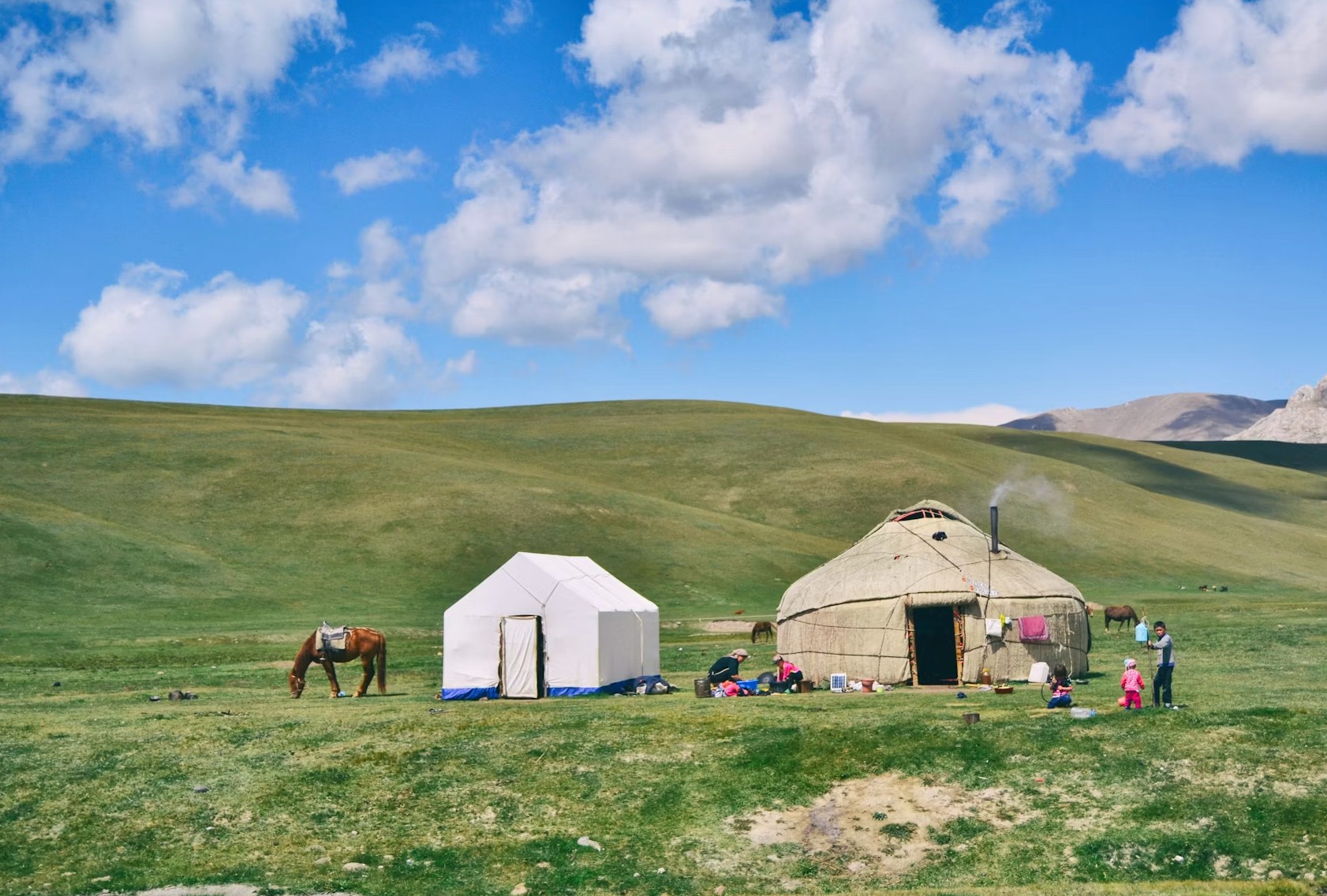
Song-Kol illustrates the difference well. Once you are at the lake, a simple yurt stay can be reasonably priced, particularly when meals are included. The expensive part is often reaching the lake or turning the visit into an organized horse trek. Community Based Tourism Kyrgyzstan currently lists a three-day Song-Kol horseback itinerary at $385 for groups of four or more, including yurt accommodation and meals.
Kel-Suu can require even more planning because it lies in a remote border region and organized trips may include permits as well as off-road transport. The lesson for budgeting is simple: do not multiply the cost of a day in Bishkek by ten and assume you have calculated the cost of a ten-day Kyrgyzstan trip.
If you are still deciding how many remote areas to include, the guide to how many days you need in Kyrgyzstan is useful before committing money to transfers and tours.
Accommodation can stay cheap even when you stop backpacking
Hostels and locally run guesthouses offer much better value than relying exclusively on conventional hotels. Karakol remains particularly inexpensive for backpackers: current Hostelworld listings include dorm beds from roughly £6–9 at several properties, while private rooms and guesthouses remain widely available.
Bishkek has a broader hotel market and becomes noticeably more expensive if you move into standard international-style accommodation. Booking.com currently puts the average three-star hotel at about $62 per night and the average four-star hotel around $92–93. Budget travelers do not need to pay those averages, however, because the city also has hostels, apartments and guesthouses below that level.
For couples, a private guesthouse can be particularly economical because the room cost is split between two people. In regional towns, choosing a family-run guesthouse can also reduce food spending when breakfast is included.
Eating local keeps food spending surprisingly low
Food is unlikely to be the expense that breaks a Kyrgyzstan budget. Current national price data puts an inexpensive restaurant meal at about 500 KGS, while a three-course mid-range meal for two averages around 2,000 KGS. A cappuccino is roughly 190 KGS.
Travelers can keep costs lower by eating dishes that are part of everyday local dining rather than seeking out international restaurants. Lagman, manty, plov, samsa and shorpo are readily available in cafés, markets and canteens, while Karakol is particularly known for ashlyan-fu. International cafés, imported food and fashionable restaurants in Bishkek can cost several times more than an ordinary local meal.
A practical food allowance of around €10–15 per day is possible for a budget traveler eating mostly local food. €20–30 provides much more flexibility for cafés, restaurants and drinks without requiring much attention to individual prices.
A rental car saves time, not necessarily money
Renting a car is difficult to justify for an itinerary that stays on the Bishkek–Issyk-Kul–Karakol corridor. Public transport already serves those routes, and the difference between a few-euro marshrutka fare and a full day of car rental is substantial.
A car becomes more useful when several remote destinations are grouped into the same itinerary. It can replace multiple private transfers and gives you control over stops that public transport does not serve. The economics also improve quickly when three or four people share the rental and fuel costs.
The mistake is automatically paying for a serious 4×4 because Kyrgyzstan is mountainous. Many major roads do not require one, while the premium for a high-clearance vehicle can be considerable. Check the roads on your actual itinerary before choosing the vehicle. The First2Travel Kyrgyzstan car rental guide covers vehicle choice, road conditions and the situations where the extra cost of a 4×4 is justified.
Spend more when it removes a real transport problem
The cheapest option is not always the best use of a short trip. Shared taxis can be worthwhile when they cut a slow or inconvenient marshrutka journey, particularly if several travelers divide the fare. A private driver can also make financial sense when one vehicle replaces an organized tour for a small group.
The same principle applies to mountain excursions. Paying more for Song-Kol or another remote destination may be worthwhile because there is no straightforward public alternative. Paying for taxis around central Bishkek, by contrast, usually buys convenience rather than access to something you otherwise could not reach.
This distinction is useful when deciding where to cut costs. Save money aggressively on city transport, ordinary intercity routes and local meals, then preserve part of the budget for the sections of the trip where spending more genuinely expands what you can see.
Cash is still important outside Bishkek
Card payments are increasingly practical in Bishkek, particularly at supermarkets, modern restaurants and hotels, but a mountain-focused trip cannot be planned around cards alone. Marshrutkas, markets, small guesthouses, yurt camps and local drivers often require Kyrgyz som, and remote destinations may not have an ATM nearby.
Withdraw cash before leaving larger towns and keep smaller denominations available for transport and everyday purchases. There is little benefit in carrying the whole trip budget in cash, but arriving at a remote yurt camp expecting card payment is a much bigger problem than carrying a modest amount of som.
Summer does not make everything expensive
July and August are the main mountain season, but ordinary Kyrgyzstan prices do not suddenly become expensive because it is summer. Local meals, Bishkek buses and standard intercity transport remain inexpensive.
The seasonal premium is concentrated in the services with limited supply: popular yurt camps, mountain guides, horse trips and suitable rental vehicles. Travelers who want a serious mountain itinerary but have flexible dates may find June or September a better compromise between accessibility and demand. The month-by-month Kyrgyzstan weather guide explains which mountain areas are practical at different times of year.
What should you actually budget?
For a mostly independent trip using hostels or inexpensive guesthouses, eating local food and traveling between Bishkek, Issyk-Kul and Karakol by public transport, €30–45 per person per day is realistic. That is where Kyrgyzstan genuinely feels like a very cheap destination.
If the trip includes Song-Kol, occasional shared taxis, private accommodation and a few paid activities, plan closer to €55–85 per day. This range is more forgiving and better reflects the type of itinerary most visitors actually want. Travelers building the trip around private 4×4 transport, horse treks and several remote regions should expect some €100–160+ days.
Kyrgyzstan is therefore cheap where local infrastructure already exists. The main budgeting challenge is paying to bridge the gap between towns and the mountain landscapes beyond them. Keeping ordinary days inexpensive and spending selectively on those logistics is usually a better strategy than trying to force every day of the trip into the same low budget.
 admin
admin